

Table of Contents
- Why Active Wellness Programs Drive Employee Engagement in 2026
- The Measurable Benefits: Productivity, Retention, and Morale
- Workplace Wellness Program Ideas for Small Teams
- How to Organize a Small Office Pickleball League
- Measuring ROI of Employee Wellness Programs
- Making Active Wellness Stick: Remote, Hybrid, and Inclusive Approaches
- Frequently Asked Questions
Last Updated: October 2, 2026
Why Active Wellness Programs Drive Employee Engagement in 2026
Active wellness is the practice of building movement, sport, and shared physical activity into the workday rather than treating health as a solo, off-hours pursuit. According to HR.com's Future of Employee Well-being 2026 report, 54% of HR professionals say well-being initiatives directly improved employee engagement, and 49% reported higher retention. That is the core case for active wellness programs: they do not just make people healthier, they make them more connected to the job.
The Engagement Gap: What Traditional Wellness Gets Wrong
Most legacy programs fail because they are passive. A pamphlet about stress, a portal nobody logs into, a reimbursement form for a gym membership that goes unused. High-engagement programs achieve 25-35% healthcare cost reduction, while low-engagement programs manage only 5-10%, according to Roundstone Insurance's 2026 analysis. The difference is participation, not budget. Active formats, from lunchtime walking groups to a casual office league, give employees a reason to show up that a PDF never will.
The Measurable Benefits: Productivity, Retention, and Morale
The clearest payoff of active wellness programs is productivity. A 2026 benchmark report found that 91% of organizations say wellness programs improve employee productivity, and 87% report they help reduce healthcare costs, per Wellhub's ROI of employee wellness programs report. Morale follows the same pattern: shared activity builds the informal trust that makes teams work better together.
Reducing Absenteeism and Presenteeism
Active programs cut both kinds of lost time. Wellness programs can reduce absenteeism by 14-19%, and employees report a 60% increase in productivity when present, according to Zippia's 2026 employee wellness statistics. Presenteeism, where people show up but contribute little, is the quieter cost. Movement breaks and team sport address it directly by resetting focus and energy mid-day.
Improving Employee Retention and Talent Acquisition
Retention improves when wellness is visible in the employee experience. A seven-year chronic disease and lifestyle program reduced healthcare costs by $30 per employee per month, according to American College of Sports Medicine research. Candidates notice this too. A wellness strategy that includes real activity signals a workplace that invests in people, which strengthens talent acquisition.
Workplace Wellness Program Ideas for Small Teams
Small teams have an advantage: low coordination overhead and fast feedback. The best workplace wellness program ideas for small teams are cheap, social, and repeatable. Pick two or three, run them for a quarter, and drop whatever nobody attends.
- Lunchtime walking meetings for one-on-one check-ins
- A step or activity challenge with a simple shared leaderboard
- Weekly team sport session, such as pickleball at a nearby court
- Standing stretch breaks scheduled into the calendar
- Healthy snack station replacing the candy bowl
- Mental health check-in built into weekly standups
How to Organize a Small Office Pickleball League
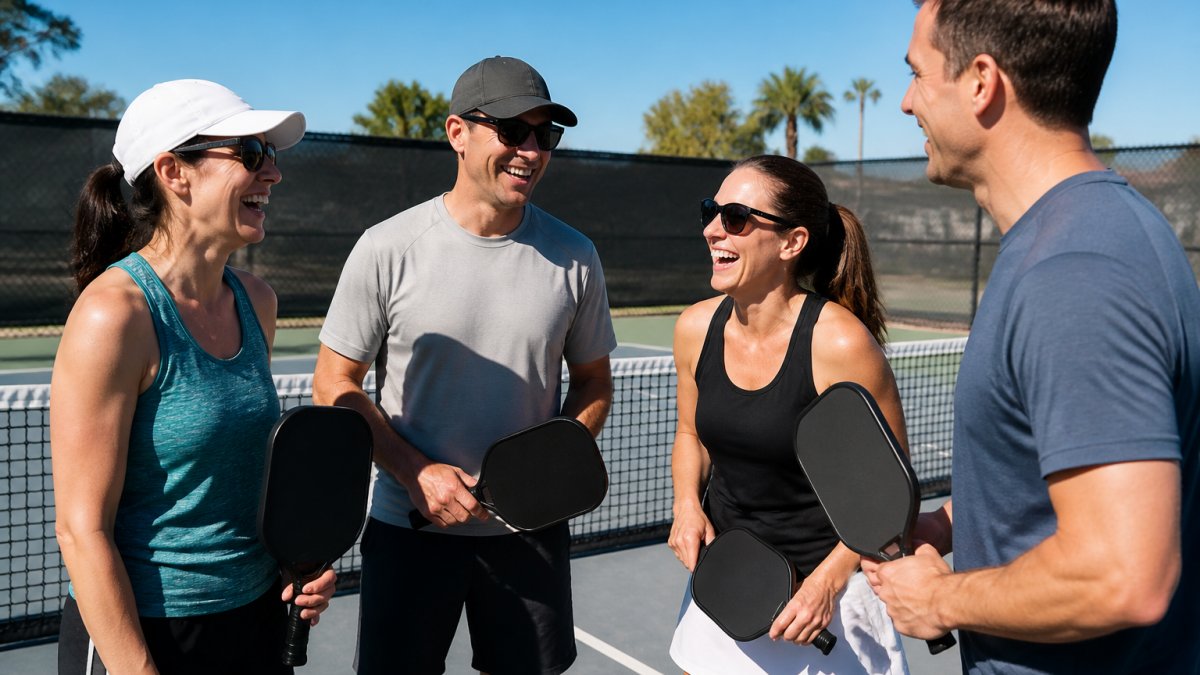
A small office pickleball league is the highest-engagement option on this list, and it takes about two weeks to set up. Pickleball works because it is easy to learn, playable in under an hour, and social by design. Here is how to organize a small office pickleball league from scratch.
- Survey interest and availability. Aim for 8-16 players, enough for rotating doubles.
- Book courts. Reserve two courts for a recurring weekly slot, ideally right after work.
- Set a simple format. Rotating doubles with short games to 11 points keeps everyone involved.
- Assign a volunteer coordinator. One person handles scheduling and reminders.
- Provide shared gear. A set of paddles and balls removes the biggest barrier to entry.
- Track standings loosely. A light leaderboard adds fun without turning it into a second job.
- Wrap with a final event. End the season with a casual tournament and prizes.
Measuring ROI of Employee Wellness Programs
Measuring ROI of employee wellness programs starts with a baseline, not a spreadsheet. Capture participation, absenteeism, and a short engagement survey before you launch, then compare at 90 days and one year. Wellness programs generate $3.27 in medical cost savings and $2.73 in absenteeism reductions for every $1 invested, according to FitOn Health's 2026 corporate wellness ROI analysis.
| Metric | What to Track | Target Signal |
|---|---|---|
| Participation rate | Active users / total employees | 40-60% or higher |
| Absenteeism | Sick days per employee | 14-19% reduction |
| Engagement | Quarterly pulse survey | Upward trend |
| Healthcare costs | Annual claims data | 25-35% reduction |
| Retention | Voluntary turnover rate | Year-over-year decline |
The Cost Side Nobody Puts in the Table
ROI is a fraction, and most articles only fill in the numerator. The denominator is the real work. For a 50-person team, a modest active program usually carries four cost lines:
- Facility or court time. A recurring weekly reservation at a municipal or private court typically runs $20-$60 per hour depending on market and season.
- Shared gear. A starter set of paddles and balls for 8-16 players is a one-time cost, and branded equipment can be ordered in small quantities rather than by the pallet.
- Coordination time. Budget two to four hours per month of one person's time for scheduling, reminders, and standings.
- Incentives. Prizes, snacks, or a small stipend for the season finale.
Why Participation Decays, and What to Do About It
Most programs peak in week three and slide after that. The behavioral science explanation is straightforward: novelty fades, the cue disappears, and the reward stops arriving. Three mechanisms counter it.
- Habit stacking. Attach the activity to an existing routine. A walking one-on-one that replaces a scheduled check-in inherits the calendar invite as its cue, so it survives when motivation drops.
- Variable reward. A fixed leaderboard gets boring. Rotating formats, surprise prizes, and short seasons keep the reward unpredictable enough to hold attention.
- Social accountability. Teams outperform solo formats because skipping means letting a specific person down, not just failing a personal goal.
A 90-Day Measurement Cadence
- Week 0: Baseline participation, sick days, and a three-question engagement pulse.
- Week 4: First participation check. If it is under 30%, change the format before adding incentives.
- Week 12: Compare against baseline on absenteeism and the pulse survey. Decide what to keep and what to cut.
- Month 12: Pull annual claims and turnover data for the full ROI calculation.
The teams that measure this way can defend their numbers in a budget meeting. The teams that only track sign-ups cannot.
Making Active Wellness Stick: Remote, Hybrid, and Inclusive Approaches
Long-term behavior change is where most programs quietly die, and the fix is designing for how people actually work now. Employees expect support across mental, physical, financial, and women's health needs, according to NIS Benefits' 2026 employee wellness trends, and 61% of employers already provide wellness-related benefits like EAPs or on-site clinics, per Yuna.io's 2026 workplace wellness statistics. Most competitors stop there.
Remote and Hybrid: Design for the Distributed Team First
A walking group does nothing for a team spread across three time zones. Remote-friendly active wellness needs asynchronous formats and a stipend that removes the equipment barrier.
- Asynchronous challenges. Run step, movement, or hydration challenges on a shared platform where people log activity on their own schedule. A weekly leaderboard post keeps it visible without requiring a live event.
- Activity stipends. A monthly reimbursement for a gym, a class, or a piece of home equipment works better than a single annual benefit because it reinforces the habit every month.
- Optional in-person anchors. For hybrid teams, schedule one quarterly meetup around an activity rather than a meeting. The activity gives remote colleagues a reason to attend and a shared memory afterward.
- Virtual co-working movement breaks. A five-minute camera-on stretch at the start of a recurring team call is low-effort and surprisingly sticky.
Inclusivity: Build for the Least Athletic Person in the Room
If the program only works for people who already play sports, it is not a wellness program, it is a club. Inclusivity is a design constraint, not a slogan.
- Offer low-impact and adaptive options. Walking, seated movement, swimming, and adaptive sport formats let people with injuries, disabilities, or low fitness participate without a separate track.
- Remove the competition default. Not everyone wants a leaderboard. Offer a participation-based track alongside the competitive one so people can opt into the intensity they want.
- Watch the scheduling. A 6 p.m. league excludes parents and caregivers. A lunchtime option excludes people with packed midday calendars. Offering both is the only way to reach a mixed workforce.
- Check the gear. Shared equipment should fit different body types and skill levels. A single paddle size or a single pace of play quietly signals who belongs.
Psychological Safety: The Angle Most Programs Miss
Psychological safety is the shared belief that you can take an interpersonal risk without being punished. It sounds unrelated to wellness, but it is the mechanism that makes active programs work. When an employee joins a lunchtime game, they are risking looking unskilled in front of colleagues. If that risk feels unsafe, they will not come back.
Three practices protect it:
- Frame wellness as support, never as surveillance. Do not track individual activity data, and say so explicitly.
- Let participation be optional and invisible. No public roster of who joined and who did not.
- Model it from the top. When managers play badly and laugh about it, everyone else gets permission to do the same.
Frequently Asked Questions
What are the benefits of employee wellness programs?
Active wellness programs deliver measurable returns: $3.27 in medical cost savings and $2.73 in reduced absenteeism for every $1 invested, according to FitOn Health (2026). HR.com's 2026 report found 54% of HR professionals see engagement improvements, 51% report better employee experience, and 49% note higher retention. Programs also cut absenteeism by 14-19% (Zippia, 2026) and boost on-the-job productivity by 60%.
How can employers measure the success of active wellness initiatives?
Track participation rates, healthcare cost trends, absenteeism data, and engagement survey scores before and after launch. High-engagement programs achieve 25-35% healthcare cost reduction versus 5-10% for low-engagement ones (Roundstone Insurance, 2026). Effective programs with built-in engagement tools hit 40-60% participation (Husk Wellness, 2026). Pair quantitative metrics with qualitative feedback to capture the full measuring ROI of employee wellness programs picture.
What are some low-cost active wellness activities for small offices?
Start with a walking meeting schedule, a lunchtime pickleball league using shared paddles, step-count challenges, or group stretch breaks. A small office pickleball league needs only a court reservation and a handful of paddles, and custom-branded paddles can be ordered. These options require minimal budget while still driving the physical activity and social connection that improve employee engagement and morale.
How does physical activity in the workplace improve employee engagement?
Physical activity reduces stress, improves mood, and creates shared social experiences that build team cohesion. Employees participating in active wellness programs report a 60% increase in productivity while present (Zippia, 2026). The National Center for Biotechnology Information notes workplace wellness programs cover over 50 million workers, and HERO (2024) found that higher engagement and variety of initiatives significantly predict program effectiveness, directly linking movement to stronger employee engagement.
The hard part is not choosing a wellness idea. It is sustaining participation once the novelty fades. Salted City Sports helps HR teams and club organizers keep momentum with fully customizable, USA Pickleball Approved paddles, an expert in-house design team, and no minimum order requirements, so a small league or a company-wide event gets the same quality gear. Get started with Salted City Sports and give your team equipment they will actually want to use.