


Table of Contents
- Carbon Fiber vs Fiberglass Pickleball Paddle: What Changes Durability
- Pickleball Paddle Durability: What Actually Wears Out First
- Carbon Fiber Pickleball Paddle Lifespan: What to Expect by Playing Frequency
- How Paddle Construction Changes Material Durability
- Power vs Control: How Durability Affects Performance Over Time
- How to Care for a Pickleball Paddle: Practical Steps That Extend Life
- Repair, Warranty, and When to Replace Your Paddle
- Frequently Asked Questions
Last Updated: October 12, 2026
Carbon Fiber vs Fiberglass Pickleball Paddle: What Changes Durability
Carbon fiber vs fiberglass paddle durability explained comes down to one core fact: the two materials fail in different ways, not at different speeds.
At Salted City Sports, we build paddles from both materials, and we field the same question constantly: which one lasts longer?
This guide breaks down what actually wears out, how playing frequency changes the math, and how to get more months out of whichever paddle you own.
Pickleball Paddle Durability: What Actually Wears Out First
Paddle durability is the measure of how long a paddle keeps its original performance, not just how long it stays in one piece.
Three failure points show up again and again:
- Surface grit loss on the paddle face, which kills spin first
- Core crushing near the sweet spot, which softens power
- Edge guard separation, which lets moisture and debris reach the core
The paddle face usually goes first. Players notice their spin dropping before they notice anything else.
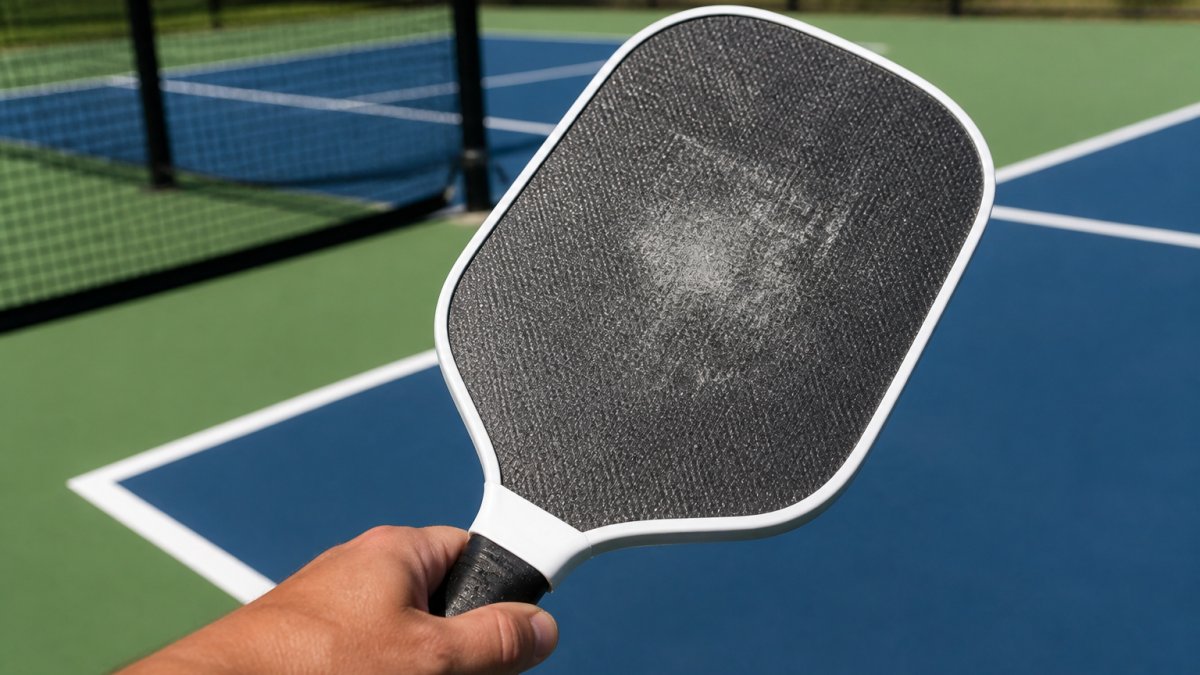
Surface Grit and Texture Breakdown
Spin comes from friction between the paddle surface and the ball. Carbon fiber paddle faces typically hold their texture longer because the material resists abrasion at the surface. Fiberglass faces can smooth out faster under heavy play, especially if you hit with a lot of topspin.
Once the grit wears down, no amount of technique brings the spin back. That is the point where many players replace a paddle that still looks fine.
Core Crushing and Edge Guard Damage
The honeycomb core takes a beating every time you strike the ball. Repeated impacts compress the cells closest to your most common contact point. Over time, that area loses its rebound, which is why an older paddle feels dead even when the face looks intact.
Edge guard damage accelerates this. A cracked or peeling edge guard exposes the core to moisture, and a swollen core is a dead paddle.
Carbon Fiber Pickleball Paddle Lifespan: What to Expect by Playing Frequency
Carbon fiber pickleball paddle lifespan depends far more on how often you play, how hard you hit, and how the paddle is built than on the face material alone.
Here is a practical way to think about it, based on how quickly surface grit wears and how fast honeycomb cores compress under regular contact:
| Playing Frequency | Typical Surface Life | Typical Core Life |
|---|---|---|
| Once a week, recreational | 12-18 months | 18-24 months |
| 2-3 times a week | 8-12 months | 12-18 months |
| Daily or competitive | 4-8 months | 8-12 months |
These ranges assume a well-bonded paddle stored out of extreme heat and used with a normal mix of drives, dinks, and resets. Your grip, your stroke, and how hard you hit all shift the numbers.
What Actually Drives the Range
Four variables move a paddle up or down that table more than the face material does:
- Contact volume. A three-game session at open play can involve 200-plus ball strikes. A daily player can put a paddle through tens of thousands of impacts in a year, and each one compresses the core cells nearest the sweet spot a little more.
- Spin load. Heavy topspin drags the ball across the face on every swing, which is the fastest way to smooth out surface grit. Players who hit flat wear the face more slowly.
- Impact force. Hard drives and overheads transfer more energy into the core than dinks and resets. A power hitter can crush a core in months that a soft-game player would take years to match.
Why the Face and Core Age at Different Rates
The face and the core do not fail on the same schedule, which is why a paddle can feel "old" while still looking new. Surface grit typically goes first because friction wears it down with every spin shot.
That gap matters when you are deciding whether to replace a paddle. If your spin has dropped but the core still feels solid, you are losing performance, not structural integrity.
A Simple Way to Track Your Own Lifespan
Rather than guessing from a table, log two things: how many sessions you play per month, and how your spin and pop feel compared to when the paddle was new. Most players notice a meaningful drop in spin within the first 30 to 40 percent of the paddle's total life, well before the core softens. Tracking that decline gives you a real replacement signal instead of a calendar guess.
The takeaway: if you play daily or competitively, expect to replace your paddle roughly once a year regardless of material. If you play once a week, a well-built paddle from either material can last two years or more with proper care.
How Paddle Construction Changes Material Durability
Construction quality decides whether a good material reaches its potential. The face material gets the marketing attention, but the bonding and layup determine real-world lifespan.
Three construction factors matter most:
- Bonding between face and core. Weak adhesive fails early and causes delamination, where the face separates from the core.
- Edge guard fit. A tight, well-sealed edge guard keeps moisture out of the core.
- Core density and cell wall thickness. Thicker cell walls resist crushing longer under heavy impact.
A fiberglass paddle with excellent bonding will outlast a carbon paddle with sloppy layup every time. This is why we treat construction as the durability variable that actually moves the needle, not just the face material.
Power vs Control: How Durability Affects Performance Over Time
Power and control do not stay constant as a paddle ages. Both degrade, but they degrade at different rates, and the decline usually starts long before anything cracks or looks worn. That is the part most durability guides skip: a paddle can lose meaningful performance while still passing a visual inspection.
The Three Performance Layers That Wear Out
Think of a paddle as three performance layers stacked on top of each other, each aging on its own clock:
- Surface texture (spin layer). Grit and texture create friction against the ball. As the face smooths, spin drops first, often within the first few months of heavy play. You will notice serves and dinks that used to bite now float.
- Core rebound (pop layer). The honeycomb cells near your most common contact point compress over time. As they flatten, the paddle loses pop and the sweet spot feels smaller and less predictable.
- Bonding and structure (integrity layer). The adhesive between face and core, and the edge guard seal, hold the paddle together. When these weaken, you get delamination, dead spots, or a soft, flexing feel.
A paddle can lose the spin layer and part of the pop layer while the integrity layer is still intact. That is the dangerous middle zone: the paddle looks fine, passes a casual inspection, but plays noticeably worse than it did new.
How Each Material Degrades Differently
Carbon fiber tends to start out control-oriented because it flexes less and returns energy predictably. As the surface wears, you lose spin and some of that control, and the paddle starts to feel less precise on placement shots.
The result is that a worn paddle often feels unpredictable rather than simply weaker. Your shots that used to land in suddenly sail long because the core no longer absorbs energy the same way, or your drives lose pace because the rebound is gone.
What This Means for Your Game
Match your replacement timing to your playing style:
- If you play a control-oriented game built on dinks, resets, and placement, surface wear hurts you most. Watch your spin first.
- If you rely on power and drives, core compression is your bigger problem. Watch your pop and sweet-spot size.
- If you play an all-court game, you will feel the decline in both layers at once, which is why all-court players often replace paddles sooner than specialists.
A Practical Degradation Check
Once a month, run a simple comparison against how the paddle felt when new:
- Hit ten dinks and see whether the ball bites or slides off the face.
- Hit ten drives and check whether the sweet spot still feels large and lively.
- Press the center of the face and listen for any popping or hollow flexing that was not there before.
If two of those three checks feel off, the paddle has degraded past the point where technique can compensate. That is your replacement signal, even if the paddle still looks intact.
How to Care for a Pickleball Paddle: Practical Steps That Extend Life
Caring for a paddle is mostly about controlling heat, moisture, and impact. None of it is complicated, and it can add months to a paddle's working life.
Follow these steps:
- Store your paddle in a padded cover, away from direct sun and heat
- Wipe the face with a soft, slightly damp cloth after play to clear grit-clogging debris
- Avoid leaving it in a car, trunk, or garage in temperature extremes
- Skip abrasive cleaners, which strip surface texture
The two-paddle rotation is the tip most players miss. Alternating paddles roughly doubles the calendar time before either one needs replacing, and it keeps your backup ready for tournament day.
Repair, Warranty, and When to Replace Your Paddle
Most paddle damage is not repairable, and knowing the difference saves you money and frustration.
Check your warranty before you do anything. Many manufacturers cover defects like delamination or a separated edge guard, but not normal wear.
Replace the paddle when:
- Spin has dropped noticeably and the face feels smooth
- The sweet spot feels dead or inconsistent
- The edge guard is cracked, peeling, or the core feels soft
- You hear rattling inside the paddle, a sign of broken core cells
If you are ordering custom paddles for a team or event, buy a spare or two.
Durability is a construction and care story more than a material story. Buy well-built paddles from either material, store them properly, and rotate them if you play often.
Paddle wear is inevitable, but premature wear is not.
Frequently Asked Questions
Is carbon fiber more durable than fiberglass for pickleball paddles?
Carbon fiber resists perpendicular impact better and holds stiffness longer, but its edges can chip when struck at an angle. Fiberglass flexes more and may absorb impact without cracking, yet its surface grit tends to wear faster. Durability depends less on the material alone and more on construction quality, edge guard design, and how often you play.
How long does a carbon fiber pickleball paddle last?
For recreational players hitting the court two to three times a week, a well-built carbon fiber paddle typically holds its playing characteristics for six to twelve months. Competitive players who drill daily may notice reduced spin and pop within three to six months. Surface grit wears before the carbon fiber itself fails, so spin degradation is usually the first sign it is time to replace.
Does fiberglass lose its texture faster than carbon fiber?
Fiberglass surfaces tend to lose grit more quickly because the material is softer and flexes under ball impact, which gradually smooths the textured coating. Carbon fiber is stiffer, so the face resists deformation and the grit stays intact longer. Either way, cleaning your paddle after play and storing it in a cover slows texture loss significantly.
How can I make my pickleball paddle last longer?
Wipe the face with a soft damp cloth after each session to remove dirt and ball residue. Store the paddle in a protective cover away from heat and direct sunlight. Avoid dragging the edge on the court and never use abrasive cleaners on the surface. Rotating between two paddles also reduces wear on any single one, extending its useful life.