


Last Updated: November 7, 2026
Quick Summary
A pickleball paddle usually lasts from a few months to several years, so replacement depends more on condition than the calendar. Frequent players often need a pickleball paddle replacement within 6 to 18 months, while competitive players may need one sooner. Check the face for lost grit, uneven rebound and physical damage.
- Recreational players (1-2 sessions a week) typically replace a paddle every 1-3 years.
- Frequent players (3-5 sessions a week) often replace within 6-18 months.
- Competitive or aggressive players may need a new paddle in 3-6 months.
- Replace if spin drops off, a dead spot appears, or the face or core is cracked.
- Keep paddles out of hot cars, since heat damage shows up later as dead spots.
Table of Contents
- Replacement Frequency by How Often You Play
- Signs a Pickleball Paddle Needs Replacing
- A Simple At-Home Paddle Inspection Routine
- Pickleball Paddle Care and Maintenance That Extends Life
- Buying a Used Paddle: Judging Its Condition
- Choosing Your Next Paddle Based on Play and Budget
- Frequently Asked Questions
A pickleball paddle usually lasts from a few months to several years, depending on how often and how hard you play, so knowing when to plan a pickleball paddle replacement helps you avoid surprises.
Most players ask because a paddle that feels "off" leaves them wondering whether the problem is their game or their equipment. Use the timeline below as a starting point, then check the paddle itself.
Pickleball paddle lifespan depends on three things: how often you play, how intensely you play, and how well you care for the paddle between sessions. A paddle that sits in a hot car will age faster than one kept in a cover at home.
| Play Level | Typical Replacement Window | What Drives It |
|---|---|---|
| Recreational (1-2 sessions/week) | 1-3 years | Lighter use, less face wear |
| Frequent (3-5 sessions/week) | 6-18 months | More impact, faster grit loss |
| Competitive or aggressive play | 3-6 months | Heavy spin, hard hitting |
Treat these ranges as guidelines, not deadlines, condition is the better signal.
Replacement Frequency by How Often You Play
For frequent players, the surface usually shows wear first.
Casual players can expect much longer service, once or twice a week, the paddle may stay in good shape for years, provided the face and edges stay intact.
Keep a rough log of sessions. Even a simple count of games per month helps you judge when your paddle is due for a check.
Signs a Pickleball Paddle Needs Replacing
Most worn paddles give warning signs before they fail. Check for three main problems: loss of surface grit, uneven rebound, and physical damage. Start by looking at the face under good light, then run your hand across it.
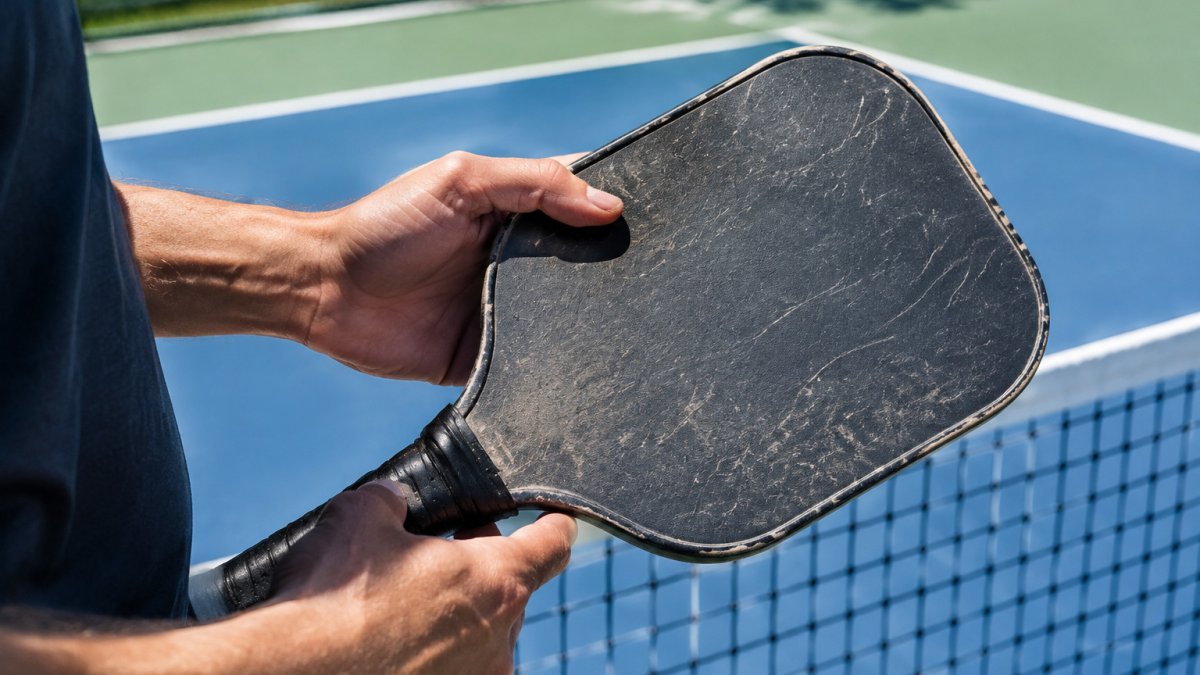
Surface Grit Loss and Spin Drop-Off
The textured surface grabs the ball and lets you put spin on it. Over time, that texture smooths out, and your serves and drop shots lose their bite even when your technique hasn't changed.
Watch for these signs:
- The face feels smooth or slick when you run your thumb across it
- Spin shots that used to dip now float or skid
- Your ball feels harder to control on short shots
Loss of surface grit is a clear reason to consider replacing a paddle, because grit that no longer grips cannot produce the spin you expect. Treat fading spin as a performance signal, not a sign that your game has slipped.
Dead Spots and Uneven Rebound
A paddle should respond the same way across the whole face. If one area feels dull or the ball pops off unevenly, the core may be breaking down.
To test this, hit the same drive several times at different spots on the face. A good paddle returns a consistent response.
Watch out: a dead spot can feel like a technique problem.
Cracks, Chips and Loose Edge Guards
Physical damage is the easiest sign to see and the most important to act on. Look along the edges and the face for cracks, chips, or any sign the layers are separating.
Check these areas:
- Face: Hairline cracks or raised bubbles
- Edges: Chips, soft spots, or gaps in the edge guard
- Edge guard: Loose, lifting, or cracked guard material
A loose edge guard is often repairable with a replacement guard, but cracks in the face or core usually mean it's time for a new paddle. Never keep playing with a cracked paddle, since a broken piece can fly off during play.
A Simple At-Home Paddle Inspection Routine
Most guides tell you to 'check for wear' and stop there, but feel is subjective: a paddle you've played with for a year feels normal even after the grit has flattened. A repeatable routine with a written baseline solves that. Set aside ten minutes once a month, or after five or more sessions, and run the same four tests in the same order.
Test 1: The Grit Friction Test
Clean the face with a damp microfiber cloth and let it dry completely, sweat and ball residue can make a good face feel slick. Then press your thumb flat against the center of the face and drag it toward you with steady pressure.
To make this less subjective, test three zones separately: center, 3 o'clock edge, and 9 o'clock edge. The center wears first because that's where most contact happens. If the center slides but the edges still grab, you have measurable center wear. Write down which zones passed and which slid, then repeat next month and compare.
Watch out: a glossy face right out of the package can feel slick for the first session or two before the texture breaks in. Don't log a new paddle as worn on day one.
Test 2: The Rebound Consistency Test
This is the test most players skip, and it's the one that catches core breakdown. Hold the paddle loosely by the handle with the face horizontal.
A healthy paddle returns the ball to a similar height from every point, with the center typically highest. A dead spot shows up as one point where the ball barely bounces back or bounces noticeably lower than its neighbors.
Test 3: The Tap-and-Listen Test
Hold the paddle by the edge guard and tap the face firmly with your knuckle at the same five points. A solid core gives a consistent, tight 'tock' across the face. A cracked core, delamination, or a separated layer gives a duller thud or a rattle at one point. This catches internal damage the rebound test can miss, especially near the handle and top edge where impacts concentrate.
Test 4: The Structural Inspection
Do this one in bright light, and do it last so cosmetics don't distract you. Run a fingernail along the seam where the edge guard meets the face; a guard that has lifted, cracked, or gone soft at the corner is a repairable issue, replacement edge guards are inexpensive and worth doing before the exposed core takes damage. Then check the face for hairline cracks, raised bubbles, or any spot where the surface layer looks separated from the core.
What Counts as a Pass, a Repair, or a Replacement
Log your results in a simple table: date, grit zones passed, rebound points even or uneven, tap test clear or dull, structural notes. After two or three months you'll see a trend instead of a snapshot.
- Pass: all four tests clean. Keep playing and recheck next month.
- Repair: a loose or cracked edge guard with a clean face and even rebound. Replace the guard before the core is exposed.
- Replace: any dead spot on the rebound test, a dull tap at one point, a face crack or bubble, or grit loss across the center zone that has measurably changed your spin. Two or more of these together is a clear signal.
Watch out: don't judge a paddle by cosmetic scuffs alone. Scratches on the face and scuffs on the edge guard are normal and don't affect performance, the tests above separate harmless marks from real defects.
Pickleball Paddle Care and Maintenance That Extends Life
Care advice is everywhere, but most of it doesn't explain why a habit matters. Once you know what actually degrades a paddle, the habits make sense, and you can judge which ones are worth your time.
What Actually Degrades a Paddle
A pickleball paddle fails through four mechanisms, each responding to a different care habit:
- Surface grit wear, the textured face loses its bite through repeated ball contact and abrasion from dirt and grit trapped on the face. Cleaning the face after play removes the abrasive particles that accelerate this.
- Core fatigue and delamination, the honeycomb core and face layers are bonded, and heat plus repeated impact stress that bond. Heat is the bigger lever: a paddle left in a hot car or sun-baked bag can reach temperatures well above what the adhesive and core were designed for, and the damage is cumulative and invisible until a dead spot appears.
- Edge guard and seam damage, the edge guard protects the exposed core edge. Once it lifts or cracks, the core edge is exposed to impact and moisture, and small damage spreads.
- Handle junction stress, the handle-to-head bond takes torque every time you twist the paddle out of a bag or drop it on its end. Carrying the paddle by the handle rather than the head, and storing it flat rather than jammed upright, reduces that stress.
Habits That Map to Those Mechanisms
- Wipe the face after every session. A dry microfiber cloth removes ball residue and court grit before it abrades the texture. This is the single cheapest habit for preserving spin.
- Keep the paddle out of heat. Don't leave it in a car, on a dashboard, or in a bag in direct sun. If you must leave gear in the car, take the paddle with you. Heat damage doesn't show up as a visible crack, it shows up months later as a dead spot.
- Use a cover in the bag. A cover keeps the face from rubbing against balls, water bottles, and other paddles, and it keeps dust off the grit. The Pickleball Paddle Cover from Salted City Sports costs $10.00 and keeps your paddle snug and protected in the bag.
Tying Care to Lifespan
There's no published formula that converts care habits into extra months, so be skeptical of anyone who offers one. Track your own paddle instead: use the inspection routine above, log results monthly, and compare your wear pattern to the play-frequency ranges in the table at the top.

Watch out: don't 'clean' a textured face with household abrasives or solvents. They can strip the texture you're trying to protect. A damp microfiber cloth and plain water are enough.
Buying a Used Paddle: Judging Its Condition
A used paddle can be a good bargain, but only if the face and core are still healthy.
Look closely at the face for grit loss, cracks, and bubbles. Hit a few balls to test rebound, since a used paddle that looks fine can still have a dead spot.
If a used paddle passes these checks but you're not sure, a new paddle may be the safer choice for regular play.
Choosing Your Next Paddle Based on Play and Budget
Your next paddle should match how and how often you play. Start with your play level, then decide how much you want to spend.
- Casual players can get good value from a mid-priced paddle that lasts years with basic care.
- Frequent players should look for a durable surface and strong spin performance.
- Competitive players may want a higher-performance paddle and should plan on replacing it more often.
The Badlands Evo-Lite Series paddle from Salted City Sports is priced at $89.99 and features a USA Pickleball approved surface, a 13mm polypropylene core, and a large sweet spot.
Whatever you choose, keep an eye on the signs covered above.
Frequently Asked Questions
How do you know when it's time to replace your pickleball paddle?
Watch for performance and condition changes rather than relying only on age. Loss of surface grit means the paddle grips the ball less and produces less spin. Uneven rebound across the face, often called dead spots, shows the core or face is no longer responding consistently. Visible cracks, chips, delamination or a loose edge guard are clear signs of structural damage. If you notice any of these, especially in combination, replacement is usually the better choice than trying to keep playing with a compromised paddle.
How often should you replace a pickleball paddle?
Replacement timing varies widely with how often and how hard you play. Playing frequency and intensity are the main drivers, so a daily or heavily competitive player should plan for more frequent replacement than a casual weekly player. Condition checks matter more than the calendar.
Can you repair a cracked pickleball paddle?
A cracked face or delaminated core generally cannot be repaired to original performance, and playing with it can change how the ball responds. Because repair options and warranty coverage depend on the manufacturer, check the warranty terms first. If the damage affects the face or core, replacement is the safer decision for consistent play.
What is the average lifespan of a pickleball paddle?
Lifespan depends on how often and how hard you play, how the paddle is stored, and the materials involved. Paddles used several times a week often wear out faster in terms of surface grit and rebound, even if they look intact. Track your own paddle's performance over time to judge its service life more accurately than any fixed estimate.
