

Table of Contents
- Pickleball vs Tennis for Corporate Team Building: The Core Differences
- Why Pickleball Team Building Activities Win on Participation
- How to Choose an Office Pickleball Tournament Format
- How to Organize a Small Office Pickleball League
- Custom Pickleball Paddles for Corporate Events
- Measuring Team-Building Outcomes and Event Logistics
- Conclusion
- Frequently Asked Questions
Last Updated: October 18, 2026
Pickleball vs Tennis for Corporate Team Building: The Core Differences
Pickleball vs tennis for corporate team building comes down to a simple trade-off: tennis offers tradition and athletic prestige, while pickleball offers speed of setup and near-universal participation. According to Sports & Fitness Industry Association participation data, 24.3 million people played pickleball in 2025, a 479% rise from 2020. At Salted City Sports, we build custom paddles for company events, so we see which format actually gets coworkers on a court together. The short answer: pickleball wins on participation, tennis wins on spectacle. Below, we break down the differences that decide your budget, your schedule, and your turnout.
Court Size, Equipment, and Space Requirements
A pickleball court measures 20 by 44 feet, roughly a quarter of a tennis court's 78 by 36 feet footprint. That size difference changes everything about venue planning. Four pickleball courts fit in the space of one tennis court, so a group of 32 can rotate through a single gym or parking lot.
Equipment matters too. Pickleball uses a solid paddle and a perforated plastic ball; tennis uses a strung racket and a pressurized ball. Paddles cost less to supply in bulk and need no stringing. Tennis rackets require grip sizes and string tensions that vary by player.
Cost Comparison: What Your Budget Actually Buys
Tennis eats more budget per participant, mostly through court rental and equipment variety. A single tennis court rental typically runs higher than a pickleball court because fewer players fit per booking. You also need rackets in multiple grip sizes, plus fresh balls that lose pressure quickly.
Pickleball spreads cost across more people. One court hosts doubles matches for eight players at a time, and a standardized paddle fits nearly every hand. Custom branded paddles double as take-home gifts, which stretches the spend further. We price our Custom Logo Pickleball Paddle at $124.00, a per-person cost that covers both the activity and the keepsake.

| Factor | Pickleball | Tennis |
|---|---|---|
| Court footprint | 20 x 44 ft | 78 x 36 ft |
| Players per court (doubles) | 4 | 4 |
| Learning curve | Minutes | Weeks |
| Equipment variety | One paddle size | Multiple grip sizes |
| Best for | Large mixed groups | Smaller athletic groups |
Why Pickleball Team Building Activities Win on Participation
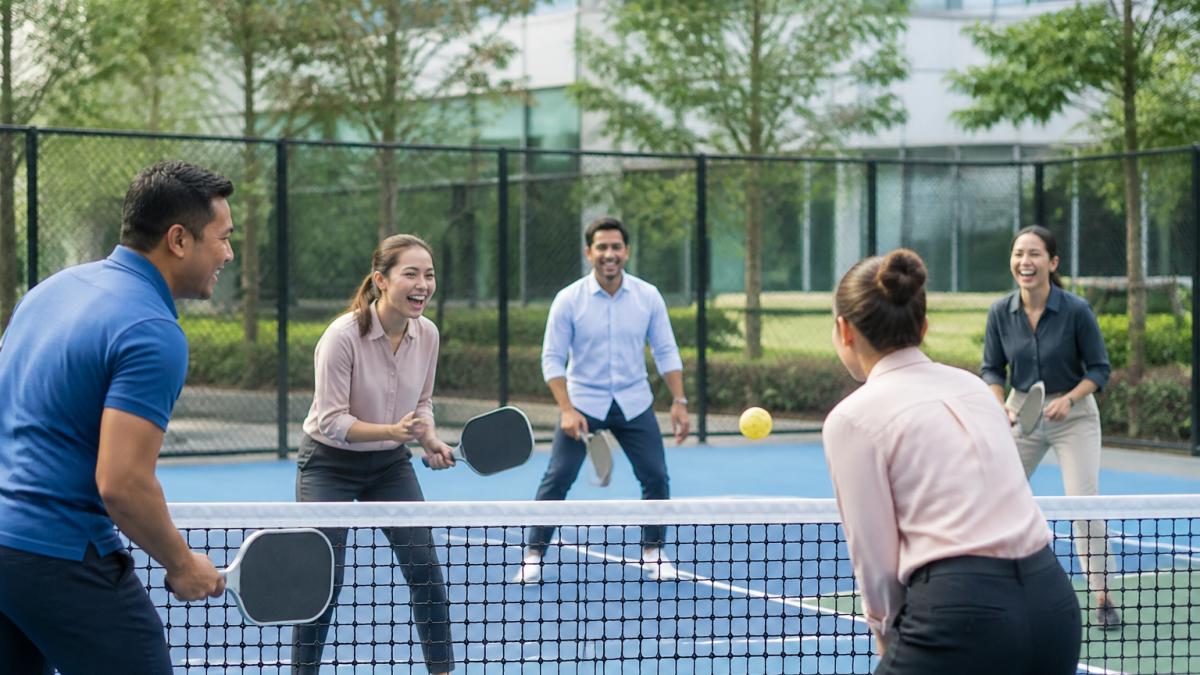
Participation is the metric that separates a team-building win from an awkward afternoon. Pickleball team building activities pull in non-athletes because the learning curve is measured in minutes, not weeks. The smaller court and slower ball give beginners a real chance to rally on day one.
Ease of Learning and Mixed-Skill Play
A beginner can serve and rally within ten minutes of picking up a paddle. That speed matters when your group spans a college athlete and someone who hasn't held a racket since high school. Mixed-skill play works because the underhand serve and small court reduce the power gap.
Tennis punishes beginners. The serve alone takes weeks to make reliable, and a strong player can overwhelm a novice without trying. Pickleball's low-stakes competition keeps weaker players in the game, which is exactly what team dynamics need.
Accommodations and Injury Considerations
Pickleball is easier to adapt for mixed abilities, but it is not automatically low-impact. The smaller court invites quick direction changes, and some players report more abrupt reactions than tennis demands. Plan for warm-ups and offer a casual rally station for anyone who wants to sit out the fast games.
Accommodations are straightforward: shorter games, rotating substitutes, and seated scoring roles keep everyone involved. Tennis offers fewer easy adaptations because court size and serve mechanics limit how much you can slow the game down.
How to Choose an Office Pickleball Tournament Format
The right office pickleball tournament format depends on headcount and time, not on skill. For groups under 20, a round robin works best. For 20 to 60 people, run a rotating doubles ladder so everyone plays multiple short games.
Match length drives the schedule. Play to 11 points, win by two, and cap each match at 15 minutes. With four courts and 32 players, you can run a full round robin in about two hours, including warm-up and breaks.
- Round robin: Best for 8-20 players, guarantees every pair meets
- Rotating doubles ladder: Best for 20-60, keeps courts full
- Single elimination: Fast but sidelines half the group early, avoid for team building
- King of the court: Fun and casual, ideal for mixed skill levels
How to Organize a Small Office Pickleball League
Organizing a small office pickleball league takes four decisions: when, where, who, and how you track it. A six-week league with one weekly session fits most offices. Book a consistent venue, then set fixed teams of two so coworkers build familiarity.
Keep the format simple. Play two 15-minute matches per session, rotate opponents weekly, and post a running standings board. A league works because repetition builds relationships that a single event cannot. Add a light prize for the top team, and consider branded paddles as the season trophy.
Custom Pickleball Paddles for Corporate Events
Custom pickleball paddles for corporate events solve two problems at once: they give every participant matched gear and they send people home with something they will actually use. We make this easy at Salted City Sports. Our Custom Team Pickleball Paddle starts at $124.00 with full-surface design and no minimum order, so a 15-person outing gets the same treatment as a 200-person tournament.
Custom Logo Pickleball Paddle →

Every paddle is USA Pickleball Approved and built on our Evo-Lite platform, so the customization never costs you performance. Our in-house design team handles the artwork, and orders ship in one to three weeks. If you want a fully bespoke look, the Build Your Own Pickleball Paddle at $149.00 lets you name and design the whole surface.

Measuring Team-Building Outcomes and Event Logistics
This is where most corporate event plans fall apart: the format sounds fun, but nobody has mapped the schedule, the court count, or how you will prove the event worked. Competitors rarely cover either half in detail. Here is the logistics and measurement playbook. Establishing clear metrics for success ensures that your chosen corporate entertainment options actually foster the intended team cohesion rather than just filling time.
Capacity Planning: Courts, Rotations, and Time
The core throughput rule: one court runs one doubles match at a time, four players on court. With 15-minute caps (play to 11, win by two), a single court cycles roughly four matches per hour, so about 16 player-slots per hour in rotation. A 40-person event in a two-hour window therefore needs at least three courts to keep everyone playing rather than waiting.
Build the schedule backward from match length:
- Match cap: 15 minutes, play to 11, win by two.
- Rotation buffer: 3-5 minutes between matches for water and re-pairing.
- Warm-up and clinic: 15-20 minutes at the start.
- Breaks: one 10-minute midpoint break for groups over 30.
With four courts and 32 players, a full round robin fits in about two hours including warm-up and breaks. For 20 to 60 people, a rotating doubles ladder keeps courts full and pairs people across departments rather than locking them into fixed teams.
Keeping Idle Participants Engaged
The real logistics risk is the bench. Plan for it:
- Rally station: a casual court or wall for anyone waiting or sitting out fast games.
- Seated scoring roles: rotate non-players into scorekeeping so they stay involved.
- Substitute rotation: swap players every match so no one sits more than one cycle.
- Side activities: a paddle-decorating or photo station fills gaps between matches.
Measuring Outcomes Before and After
Measure three numbers, and capture a baseline before play starts:
- Participation rate, invited employees who actually played, not just attended.
- Cross-team interaction, count how many matches paired people from different departments; a short pairing log makes this concrete.
- Post-event survey, two questions on enjoyment and new connections, plus one on whether they would play again.
Run the same two-question survey as a pre-event baseline so you can report a before-and-after change rather than a single post-event score. That comparison is what turns a fun afternoon into a defensible team-building result.
Logistics Checklist
- Book courts two to three weeks out and confirm restroom and parking access.
- Assign one facilitator to run the schedule and one to manage equipment.
- Bring water, a first-aid kit, and spare paddles.
- Confirm whether the venue will stripe tennis courts for pickleball.
- Print or post the rotation so players know when they are up next.
Logistics and measurement are the same job: a schedule that keeps everyone playing produces the participation and cross-team numbers you will report afterward.
Conclusion
The hardest part of corporate team building is getting everyone to show up and actually play. Pickleball removes that barrier with a short learning curve, flexible formats, and gear that fits any hand. Salted City Sports makes the equipment side simple, with USA Pickleball Approved paddles, full-surface customization, no minimum orders, and fast turnaround. Get started with Salted City Sports and put a branded paddle in every player's hand at your next event.
Frequently Asked Questions
Is pickleball easier for beginners than tennis?
Yes, for most corporate groups. Pickleball's smaller court, underhand serve, and lightweight paddle shorten the learning curve, so employees with no racket-sport background can rally within minutes. The sport had 24.3 million U.S. participants in 2025, according to the Sports & Fitness Industry Association, and that growth is partly driven by how quickly new players can join a game. Tennis requires more court coverage and stroke technique before points become fun, which matters when you have a mixed-skill team and a single afternoon.
How many employees can play pickleball at a company event?
A single pickleball court comfortably hosts four players in doubles, and with rotation you can cycle a group of 12 to 16 through one court in about an hour. For larger groups, book multiple courts or run a round robin so everyone stays involved. If you are planning pickleball team building activities for 30 or more people, reserve at least four courts and assign a facilitator to manage rotations. Doubles formats keep participation high and waiting time low.
How long should a corporate pickleball team-building event last?
Two to three hours works for most companies. That window covers a welcome and rules briefing, a warm-up, a round robin or bracket of short games, and time for food and socializing. Researchers cited by TheSkimm found the average pickleball session runs 90 minutes, so plan at least that much active court time. If you are running an office pickleball tournament format with a bracket, add 30 minutes for setup and scoring.
Can you combine pickleball and tennis at a corporate event?
You can, and it works best when the venue has both court types. Split the group by preference, run tennis on full courts and pickleball on smaller ones, then bring everyone together for a final mixed round or awards. The trade-off is logistics: two equipment sets, two sets of rules, and more space to reserve. For most companies, picking one sport keeps planning simpler and ensures every employee is playing rather than watching.
Do custom paddles hold up during real matches?
Quality custom paddles are built for play, not display. Salted City Sports paddles are USA Pickleball Approved and use full-surface customization rather than stickers, so the design does not peel after a few games. The Evo-Lite Series core is heat-treated polypropylene with a textured fiberglass surface for spin and control. At $124 per Custom Logo Pickleball Paddle, they work as both event equipment and a branded gift employees keep using afterward.