


Table of Contents
- Building a Professional Pickleball Gear Setup for 2026
- Quick Comparison: What Each Piece of Pickleball Equipment Costs You
- Pickleball Paddle Weight for Control: Finding Your Number
- Pickleball Paddle Thickness 14mm vs 16mm: Which Core Fits Your Game
- USA Pickleball Approved Paddles: What Tournament Compliance Actually Requires
- Pickleball Shoes for Competitive Play: Court Footwear That Holds Up
- Balls, Bags, and Nets: The Supporting Pickleball Gear Pros Carry
- Durability, Care, and When to Replace Your Pickleball Gear
- Frequently Asked Questions
Last Updated: October 4, 2026
Building a Professional Pickleball Gear Setup for 2026
Professional pickleball gear is the equipment set that competitive players rely on to play consistent, tournament-legal pickleball: a compliant paddle, the right ball for the surface, court shoes, and a bag that carries it all. At Salted City Sports, we build USA Pickleball Approved paddles for players who take their setup seriously. According to the USA Pickleball Annual Growth Report, the Professional Pickleball Registry closed 2024 with 8,754 members, a sign of how many players now treat this sport as more than a weekend hobby.
That growth changes what "good enough" means. A recreational player can grab any paddle off a shelf.
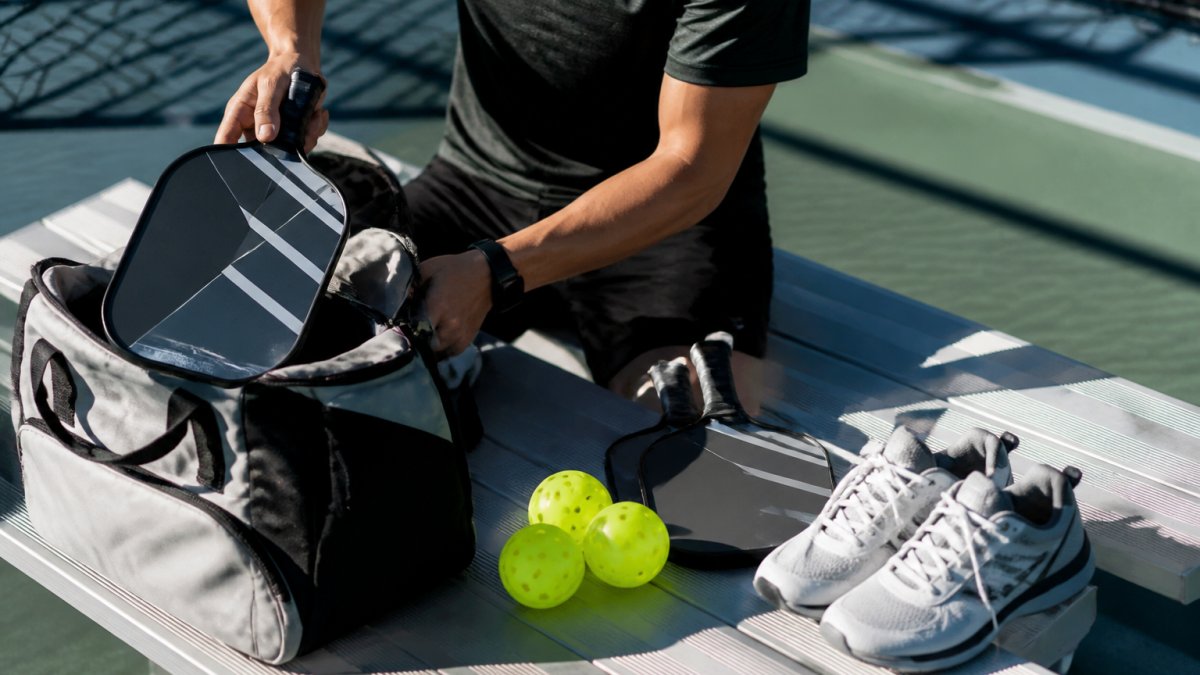
Below, we break down every piece of pickleball equipment that matters, what it costs, and how to choose without overspending.
Quick Comparison: What Each Piece of Pickleball Equipment Costs You
Paddles dominate the category, and that is not an accident. According to Branded Pickleball's 2026 statistics report, paddles account for 58% of the equipment and apparel category, while apparel takes 18%. Those two categories alone make up more than three-quarters of what players buy.
| Gear Category | What It Does | Price Range | Replacement Cycle |
|---|---|---|---|
| Paddle | Core performance tool | Varies by material and brand | 6-12 months of regular play |
| Balls | Consistency and bounce | Low, sold in packs | 5-15 sessions |
| Court shoes | Grip and ankle support | Mid to high | 6-9 months |
| Paddle bag or cover | Protection in transit | Low to mid | 1-2 years |
| Apparel and socks | Comfort and moisture control | Low to mid | 6-12 months |
| Portable net | Practice anywhere | Mid | 2-3 years |
Custom paddle pricing depends on quantity, materials, and turnaround, so check with Salted City Sports rather than assuming a list price.
Pickleball Paddle Weight for Control: Finding Your Number
The best paddle weight for control sits between 7.5 and 8.4 ounces for most competitive players. Heavier paddles (8.5 ounces and up) add power but slow your hands at the kitchen line.
Here is the trade-off in plain terms:
- Under 7.5 oz: fast hands, less power, best for quick exchanges
- 7.5-8.4 oz: balanced control and power, the competitive sweet spot
- 8.5 oz and up: maximum power, slower reaction time
A common mistake is buying the heaviest paddle you can find because a pro uses it. Grip strength and swing speed matter more than raw weight. If your arm tires by the third game, drop an ounce.
Pickleball Paddle Thickness 14mm vs 16mm: Which Core Fits Your Game
The 14mm vs 16mm pickleball paddle question comes down to one thing: the 16mm core gives more control and a softer feel, while the 14mm core gives more power and a crisper response.
A 16mm paddle absorbs pace on defensive shots and helps you place dinks; a 14mm paddle pops the ball off the face faster, suiting players with slower swings who need help generating speed.
Neither is better. The right choice depends on your style:
- Control-first players: 16mm
- Power-first players: 14mm
- All-court players: either, based on feel preference
What most guides miss is that thickness interacts with weight. A heavy 16mm paddle feels sluggish; a light 14mm paddle can feel hollow. Match both specs together.
USA Pickleball Approved Paddles: What Tournament Compliance Actually Requires
USA Pickleball approved paddles must appear on the organization's official approved paddle list before you can use them in a sanctioned event. Tournament directors check this list, and an unapproved paddle means disqualification, no exceptions. But "check the list" is the easy part, understanding what it certifies, and how to verify your exact paddle before you travel, is where most players get caught out.
What the approval test actually measures
USA Pickleball's equipment standards cover four measurable properties, each designed to keep play fair and safe:
- Deflection: how much the paddle face flexes when a ball strikes it. Too much trampoline effect and the paddle functions as a spring, inflating ball speed beyond what the rules allow.
- Surface roughness: the texture of the hitting surface, measured against a defined threshold. This is what governs how much spin a paddle can generate. A face that is too smooth plays dead; a face that is too rough gives an unfair spin advantage.
- Size limits: overall length and width, plus the ratio between them, are capped so no player gains reach or a larger sweet spot beyond the standard.
Manufacturers submit specific models for testing, and approval applies to that model, not the brand, shape, or colorway. A paddle that looks identical to an approved model may not carry approval if it was never submitted under its own model number.
The model-number trap
This is the single most common compliance failure. Two paddles can share a mold, core, and face material yet carry different approval status, because approval is tied to the exact model designation the manufacturer registered.
A related trap: a paddle can be removed from the list if a later production run fails retesting or the manufacturer changes a component without resubmitting.
A pre-tournament verification workflow
Run this before every sanctioned event:
- Find your exact model on the current USA Pickleball approved paddle list. Search the model number, not the marketing name.
- Confirm the listing is active, not expired, not withdrawn, not superseded by a newer revision.
- Check the paddle in hand against the listing: model number, face texture, edge guard, and any graphics that could be read as a prohibited modification.
- Photograph the paddle and the listing so you have documentation if a tournament director questions it at check-in.
- Re-verify if you bought the paddle more than a few months ago, since list revisions happen between seasons.
What approval does not cover
Approval is a paddle standard, not a gear standard. It says nothing about your shoes, bag, ball choice, or apparel; balls have their own specification and net height is governed separately. Treat paddle approval as one checkbox among several, not blanket clearance for everything in your bag.
Our paddles at Salted City Sports carry USA Pickleball Approved status, and we can confirm model approval before you commit to a bulk order.
Pickleball Shoes for Competitive Play: Court Footwear That Holds Up
Pickleball shoes for competitive play need three things: lateral support, a non-marking gum-rubber sole, and enough cushioning for repeated stops.
Look for shoes built for court surfaces rather than distance. The sole pattern should grip without grabbing, and the upper should hold your foot steady during lateral cuts.
- Lateral support: prevents rollover on quick direction changes
- Non-marking sole: required at most indoor facilities
- Toe durability: drag on serves wears through thin uppers fast
Replace shoes when the midsole compresses, usually every six to nine months for regular players. Worn cushioning is invisible but it shows up in sore knees.
Balls, Bags, and Nets: The Supporting Pickleball Gear Pros Carry
Balls, bags, and nets round out a complete kit, and each has a specific job. But the more useful question is what belongs in your bag for a given situation. Here is a pro kit organized by how you actually play.
The tournament kit
A sanctioned event has compliance requirements and long waits between matches. Pack for both:
- Two to four balls of the correct type for the venue. Indoor and outdoor balls are not interchangeable, and some events specify the ball. Confirm before you travel.
- A spare paddle that is also on the approved list. If your primary paddle fails inspection or cracks mid-day, you are not scrambling.
- A paddle cover for each paddle, so faces do not get dinged in a crowded bag or on a bench.
The training kit
Practice is where gear gets abused, so durability matters more than match-day polish:
- A portable net with weighted posts, set to regulation height. Regulation height matters even in practice, because drilling at the wrong height builds the wrong habits.
- A ball tube or hopper if you are running serve or dink drills. Picking up balls by hand is the fastest way to waste a practice session.
- A dedicated practice paddle you are willing to wear out. Save your match paddle for matches.
The recreational kit
For open play and casual games, the goal is a single bag you can grab without thinking:
- One paddle, one cover, one ball type matched to the court you play on most.
- A compact bag rather than a full tournament bag, you are not carrying spares you will not use.
- Court shoes kept separate from street shoes, so you are not tracking grit onto the court.
Matching the ball to the court
Ball choice is the most common supporting-gear mistake, and it is a two-variable decision: hole size and plastic hardness.
- Indoor balls: larger holes, softer feel, designed for smooth surfaces and controlled bounce.
- Outdoor balls: smaller holes, harder plastic, built to resist wind and hold up on rough surfaces.
Using the wrong ball changes the entire pace of a match. An outdoor ball on a smooth indoor floor skids and plays fast; an indoor ball outdoors gets pushed around by wind. If you play both, carry both.
Net height is not optional
A regulation net sets to 34 inches at the center and 36 inches at the sidelines (Rule Changes All). Portable nets with weighted posts are fine for practice, but check the height before you drill, a sagging or low net changes your shot trajectory and quietly trains bad habits.
- Indoor balls: larger holes, softer feel
- Outdoor balls: smaller holes, harder plastic, wind-resistant
- Paddle cover: face and edge protection
Durability, Care, and When to Replace Your Pickleball Gear
Most pickleball gear lasts six to twelve months of regular play before performance drops, and the drop is gradual enough that players miss it. A paddle's core breaks down, the surface texture smooths out, and spin quietly disappears.
Care extends lifespan: store paddles out of a hot car, wipe the face after play, and keep balls out of direct sun. Heat warps cores and degrades ball plastic faster than play does.
Evidence-based comparison beats brand loyalty: track how your gear performs and replace on data, not habit.
Competitive pickleball rewards players who treat their gear as a system, not a collection of impulse buys. Salted City Sports builds USA Pickleball Approved paddles with full-surface customization, an expert in-house design team, and no minimum order, so you can outfit one player or an entire event.
Frequently Asked Questions
What is the best pickleball gear for competitive play?
Start with a USA Pickleball Approved paddle matched to your style, then build outward. Add court shoes with lateral support, indoor and outdoor balls, a paddle cover, and a bag that fits your kit. Try gear before committing when you can.
How much should a professional pickleball paddle weigh?
Most advanced players land between 7.5 and 8.5 ounces. Lighter paddles in the 7.3 to 7.8 ounce range swing faster for quick hands at the kitchen line, while heavier options near 8.3 to 8.8 ounces add power on drives and stability on blocks. Pickleball paddle weight for control usually points toward the middle of that range, around 8.0 ounces, because it balances hand speed with enough mass to absorb pace. Demo a few weights before you buy.
Do pro pickleball players use 14mm or 16mm paddles?
Both show up on pro courts, and the split comes down to role. The pickleball paddle thickness 14mm vs 16mm choice matters because a 14mm core produces a crisper, faster exit for drives and counters, while a 16mm core absorbs pace and gives you a larger sweet spot for dinks and resets. Power-oriented players often lean 14mm, and control-oriented players lean 16mm.
How do I know if a paddle is tournament legal?
Check the USA Pickleball Approved list before you buy. USA Pickleball is the governing body for the sport's equipment standards, and sanctioned tournaments require paddles that appear on that list. Customized paddles can still qualify, but the surface texture, core, and overall dimensions must stay within spec, so any added graphics have to be applied without altering those characteristics. The Professional Pickleball Registry ended 2024 with 8,754 members, which reflects how many players now compete under these rules. Ask the seller for the approval status in writing.