

Table of Contents
- The Verdict: When Paddle Printing Pays Off
- The Real Cost of Professional Paddle Printing
- Custom Pickleball Paddle Performance: Does Ink Change How It Plays?
- Pickleball Paddle Printing Durability: What Survives Real Play
- Pickleball Paddle Printing vs Decals: Which Holds Up?
- USA Pickleball Approved Custom Paddles: What Tournament Players Need to Know
- Who Benefits Most: A Skill-Level Breakdown
- Conclusion
- Frequently Asked Questions
Last Updated: October 21, 2026
The Verdict: When Paddle Printing Pays Off
Professional pickleball paddle printing is worth it when the printed surface survives play and the paddle underneath still performs.

Here is the honest answer up front. For a corporate event, a team league, or a gift, printing is almost always worth the cost.
Below, we break down real costs, what ink does to performance, how printing compares to decals, and who actually benefits. The short version: printing is a finish, not a performance upgrade.
The Real Cost of Professional Paddle Printing
Cost per paddle depends on order size, because setup is a fixed cost and volume pricing does the heavy lifting. Our customizable paddle starts at $95.00 with a flat $15 setup fee per order, no matter the quantity.

That setup fee is the number most buyers overlook. On a single paddle it adds meaningful percentage to the total. On a 50-paddle team order it nearly disappears.
Breaking Down the Price Per Paddle
| Order Size | Setup Fee | Setup Per Paddle | What Drives the Total |
|---|---|---|---|
| 1 paddle | $15 flat | $15.00 | Setup dominates the cost |
| 15 paddles | $15 flat | $1.00 | Design work, single run |
| 50 paddles | $15 flat | $0.30 | Volume pricing kicks in |
| 100+ paddles | $15 flat | $0.15 or less | Lowest per-unit cost |
For branded corporate orders, our custom logo pickleball paddle runs $124.00, and custom team paddles are also $124.00. Players who want to design from scratch can build their own at $149.00.

The Cost-Versus-Value Math for Competitive Players
Most paddle-printing content stops at the price list.
Start with the baseline. A stock, non-custom paddle at the same performance tier is the reference point.
Run the numbers on a single paddle. A $95.00 custom paddle plus the $15.00 setup fee is $110.00 before shipping.
Now weigh the alternatives that same difference could fund:
- A grip and overgrip refresh: cheap, high-impact for feel, and something most players neglect.
- A spare paddle or a second identical frame: the most common competitive upgrade, because a cracked face mid-tournament is a real risk.
- Lead tape or a weighted setup: a low-cost way to tune balance and swing weight.
- Coaching or drilling time: often the highest-return spend for a player below the top tier.
A common pattern among competitive players is that the printed paddle is worth it only when the base frame is already the one they would buy stock.
For group buyers the math flips.
Where the Money Actually Goes
Buyers assume the print is the expensive part. In practice the fixed costs are design setup, proofing, and the production run changeover. That is why a single paddle carries the full setup burden and a 100-unit order spreads it to pennies. If budget is tight, the lever is order size, not design complexity. A simpler design does not meaningfully cut the per-paddle price at volume; a larger order does.
Custom Pickleball Paddle Performance: Does Ink Change How It Plays?
Printing does not change how a paddle plays, provided the manufacturer prints on the finished face rather than altering the surface. Custom pickleball paddle performance comes from the core, the face material, and the weight, not the ink.
That distinction matters. A 16 mm polymer core and a carbon fiber face determine control and feel. The print sits on top of that build.
Where players get burned is when a printed graphic is applied as a thick coating that changes surface texture. That can dull the grit that generates spin. Full-color print applied directly to the face avoids that problem.
Pickleball Paddle Printing Durability: What Survives Real Play
Pickleball paddle printing durability comes down to the production method. Direct printing bonds graphics into the face; stickers and decals sit on top and peel at the edges.
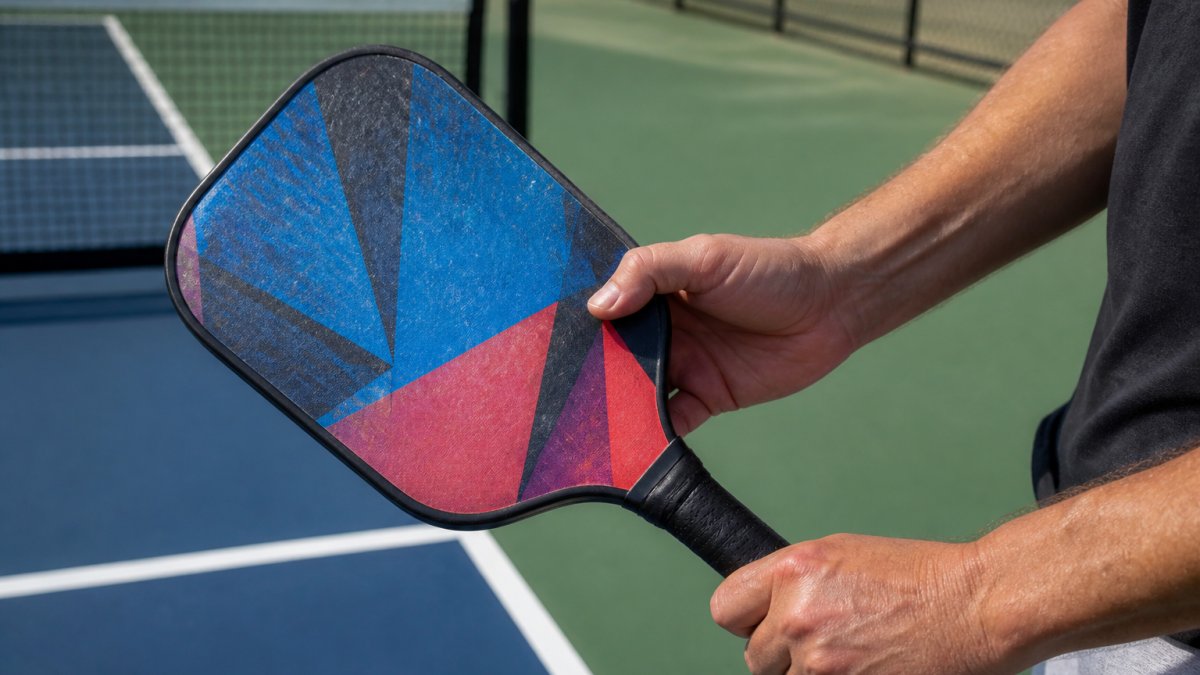
Edge-to-edge printing is the more demanding test. Graphics that run to the paddle's border have nowhere to hide a lifting corner.
Where Printed Faces Actually Wear
Durability is not uniform across the paddle. Wear concentrates in predictable zones, and knowing them tells you what to inspect before you buy and after a season of play.
- The sweet spot: the highest-contact area takes the most ball strikes and the most abrasive grit from the ball. This is where color fade and surface smoothing show up first.
- The edge guard and border: the rim absorbs court scrapes and low-ball digs. Edge-to-edge graphics are most vulnerable here because the print runs into the zone that takes the most mechanical abuse.
- The throat and handle junction: flex and hand contact concentrate here. Graphics near the throat see repeated stress and sweat exposure.
- The face center versus the perimeter: perimeter graphics often outlast center graphics simply because they see fewer ball impacts.
A practical inspection routine: after a month of regular play, look at the sweet spot under angled light. A printed face that is holding up shows consistent color and an intact texture. One that is failing shows a polished, glossy patch where the grit has worn smooth, or a color shift toward the base material.
Fading, Cleaning, and What Shortens Lifespan
The enemies of a printed face are UV exposure, abrasive court surfaces, and harsh cleaning. Most practitioners find that direct-printed graphics hold color well through normal play, but the following habits shorten lifespan regardless of print method:
- Abrasive cleaners and solvents: these can dull the surface texture and lift edge graphics. Mild soap and water with a soft cloth is the safe default.
- Storing in a hot car or direct sun: prolonged UV and heat exposure accelerate fading and can degrade the face material itself.
- Dragging the paddle on the court: scraping the edge guard and border graphics is the fastest way to wear the print at the rim.
- Stacking paddles face-to-face without a cover: grit and friction between faces abrade the print over time.
A reasonable expectation for a direct-printed face used in regular recreational or league play is that the graphic remains legible and the texture remains intact for the life of the paddle's competitive use, with the sweet spot showing the first cosmetic wear. Decals and stickers typically show lifting at the edges well before that, especially on paddles that see hard play.
How to Test Durability Before You Commit
You cannot fully judge durability from a product photo, but you can ask questions that separate a bonded print from a surface film:
- Ask whether the graphic is printed into the face or applied over it. A vendor who cannot answer clearly is a risk.
- Ask whether the face texture is preserved after printing. If the print adds a coating, spin and feel can change.
- Request a sample or a close-up of a used paddle, not a studio shot. Wear patterns are visible in real-world photos.
- Confirm the cleaning guidance the vendor recommends, and check it against the mild-soap default above.
Pickleball Paddle Printing vs Decals: Which Holds Up?
Direct printing outlasts decals in real play. A decal is a separate film or sticker applied over the face, and its edges are the first thing to lift after repeated contact. Direct printing puts the graphic into the surface, so there is no edge to catch.
The trade-offs are clear:
- Direct printing: smoother finish, better color reproduction, no peeling edges, cleaner look at the border
- Decals and stickers: cheaper for tiny runs, faster to produce, but prone to lifting and inconsistent color
For anything that will see regular court time, printing wins. Decals make sense for a one-off prototype or a giveaway that will not be played hard.
If a vendor cannot tell you whether the graphic is printed or applied as a sticker, that silence is your answer.
USA Pickleball Approved Custom Paddles: What Tournament Players Need to Know
USA Pickleball approved custom paddles exist, and the approval applies to the paddle model, not the artwork.
The safest path is ordering a custom paddle built on an approved frame. Our Core tier is USA Pickleball approved and tournament-ready, which removes the guesswork.
Competitive players worry that customization affects balance. It does not, as long as the underlying model is unchanged. The weight and sweet spot come from the build, not the border color.
Who Benefits Most: A Skill-Level Breakdown
The value of printing shifts with the buyer. Corporate and club orders get the clearest return, because branded gear doubles as marketing and equipment. Recreational players get a paddle they enjoy using. Competitive players should treat printing as cosmetic and pick their frame on performance first.
| Buyer | Printing Worth It? | Why |
|---|---|---|
| Corporate events | Yes | Branded, functional giveaway with repeat use |
| Clubs and tournaments | Yes | Team identity plus bulk pricing |
| Recreational players | Yes | Personalization at low added cost |
| Competitive players | Situational | Only if the base frame is already your pick |
A direct cost-versus-value read: if the paddle will be seen by others, printing earns its keep. If it is purely a performance tool, spend on the core and face first.
Conclusion
The hard part is not deciding whether printing looks good. It is finding a vendor whose graphics survive real matches without changing how the paddle plays. That is the gap most buyers fall into, and it is where we focus.
Salted City Sports prints your artwork edge to edge on USA Pickleball Approved frames, with no minimum order, an in-house design team, and volume pricing from single paddles up to 1000+ units.
Get started with Salted City Sports and put a design on a paddle built for real play.
Frequently Asked Questions
Does printing a design on a pickleball paddle affect its performance?
Professional paddle printing applies graphics to the paddle face without changing its core construction or weight balance. The print is a thin layer that does not alter the surface texture enough to affect control or spin in normal play. The real performance variables are the paddle's core thickness, face material, and weight, not the ink. When you order from a maker that prints on a USA Pickleball approved model, you get the same play characteristics as the stock version. Custom pickleball paddle performance depends on the tier you choose, not the artwork.
How durable is a custom-printed pickleball paddle?
Pickleball paddle printing durability depends on the production method. Direct printing bonds the graphic into the paddle face, so it resists peeling and fading far better than stickers or decals. Edge-to-edge prints on quality paddles hold up through regular recreational and league play. The areas that show wear first are usually the edge guard and the sweet spot, not the printed graphic itself. Choosing direct printing over a decal is the single biggest factor in how long your design looks sharp.
Can custom-printed paddles be used in tournaments?
Yes, as long as the underlying paddle model is USA Pickleball approved. Approval is tied to the paddle's construction and specifications, not to the graphic on the face. When you order USA Pickleball approved custom paddles, the printed version meets the same standard as the stock version. Confirm the specific tier is approved before you order, since entry-level models may not carry approval. For sanctioned events, always verify the model on the approved list rather than assuming all custom paddles qualify.
Is a custom pickleball paddle worth the extra cost?
It depends on your goal. For a competitive player, the value comes from getting a tournament-ready paddle with your own design at a price close to a stock performance paddle. For a corporate event or team, the value is branded gear people actually keep and use. At Salted City Sports, custom paddles start at $95 with a $15 flat setup fee per order, and volume pricing drops the per-paddle cost as quantities rise. Printing vs decals also matters: direct printing lasts longer, which protects your investment over time.