


Table of Contents
- Understanding Paddle Fundamentals for Professional Design
- Pickleball Paddle Parts and Materials: Choosing Your Foundation
- Pickleball Paddle Weight and Balance: Engineering Your Edge
- Professional Pickleball Paddle Design Ideas: Visual Strategy
- Custom Pickleball Paddle Graphics: Durability and Impact
- Meeting USA Pickleball Approval Standards
- From Design to Production: Your Professional Workflow
- Testing, Refinement, and Real-World Performance
- Frequently Asked Questions
Last Updated: October 17, 2026
Understanding Paddle Fundamentals for Professional Design
Designing professional pickleball paddles starts with performance: core material, surface texture, weight distribution, and handle design work together to deliver consistent results.
When you design professional pickleball paddles, every decision affects both looks and play; the best custom paddles balance both.

At Salted City Sports, the designs that succeed understand the relationship between form and function. You don't need to be an engineer, just know what questions to ask before sketching.
Pickleball Paddle Parts and Materials: Choosing Your Foundation
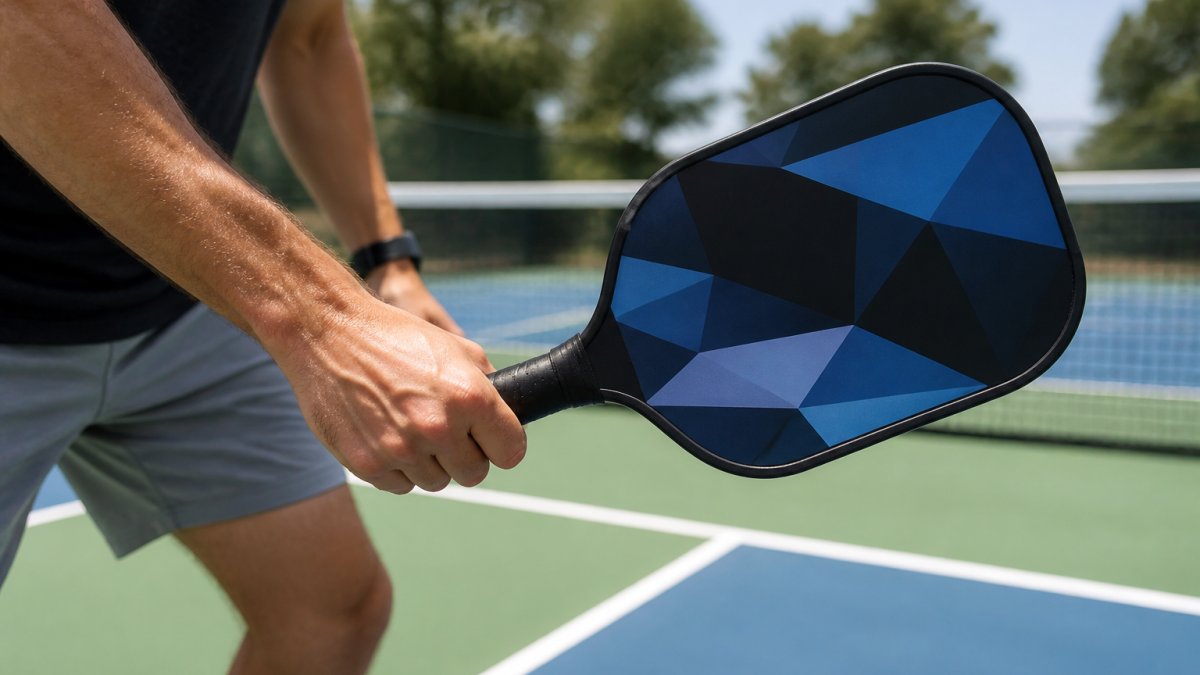
A pickleball paddle consists of distinct parts. The core absorbs impact and transfers energy. The surface is the striking face, and its texture affects spin and control. The edge guard protects the perimeter.
Core Options and Their Performance Impact
The core material you select determines the paddle's responsiveness and feel.
When you design professional pickleball paddles, match your core to your player.
Surface Selection for Spin and Control
The paddle face comes in different textures.
Tournament players prioritize spin and control over raw power; recreational players often prefer more power and forgiveness. Your surface choice should reflect that priority.
Durability matters too. A high-quality protective finish keeps graphics vibrant under UV exposure and repeated play.
Pickleball Paddle Weight and Balance: Engineering Your Edge
Weight and balance are invisible but felt immediately. Too heavy, and you tire quickly. Too light, and you lose stability. The sweet spot depends on the player's strength, style, and experience level.
Weight Distribution and Swing Weight
Swing weight describes how heavy a paddle feels during a swing, independent of actual weight. Two paddles can weigh the same yet feel different depending on where that weight sits.
Weight toward the head creates a heavier swing weight, generating more power but requiring more arm strength. Weight toward the handle improves maneuverability and reduces fatigue.
When you design professional pickleball paddles for different audiences, weight distribution becomes a design variable.
Handle Design and Grip Customization
The handle is where comfort directly impacts performance. Too thin causes gripping fatigue; too thick reduces maneuverability.
Grip size affects comfort and control.
The handle is also an opportunity for visual branding. Custom handle colors make the paddle unmistakably yours, showing up in the player's hands every time they step on court.
Professional Pickleball Paddle Design Ideas: Visual Strategy
Visual design is where your paddle becomes memorable. A well-designed paddle stands out in a rack of dozens. It signals quality and intention. But effective design balances aesthetics with readability and durability.
Color Palettes and Branding Alignment
Color choice is the first visual decision. Bold, high-contrast colors photograph well and catch the eye. Pastels feel sophisticated but can fade visually on court.
If you're designing for a brand or team, align your palette with existing branding: corporate paddles use company colors, team paddles reflect team identity, and personal paddles express individual style.
Avoid color combinations that reduce contrast: a yellow paddle face with white text reads clearly from across the court, while a light gray face with white text becomes nearly invisible.
Sketching and Prototyping Your Vision
Before committing to a full design, sketch your ideas. Rough sketches help you visualize placement, proportions, and balance; no artistic skill required.
Start with the paddle shape. Your shape is mostly fixed by performance requirements and USA Pickleball approval, but you can work within those constraints.
A paper prototype, sketching your design on a printed paddle template, shows proportions and spacing before you commit digitally.
Custom Pickleball Paddle Graphics: Durability and Impact
Graphics are where design becomes tangible. A stunning design that peels off after two weeks of play is worthless. Professional-grade graphics require professional-grade execution.
Full-Surface Customization Techniques
Full-surface customization means your artwork covers the entire paddle face, edge to edge, maximizing visual impact and creating a cohesive, branded look with no blank space or stock graphics.
Full-surface printing requires high-resolution artwork. If you're using photographs, logos, or detailed graphics, start with files at least 300 DPI (dots per inch) (DPI Meaning | What is DPI & How to Check/Change it).
Layering adds depth: a solid background with graphics on top creates visual hierarchy, and gradients or fades add sophistication. The key is ensuring every element remains legible and durable.
Build Your Own Pickleball Paddle →
Protective Finishes and Edge Guard Options
A protective finish keeps graphics vibrant and prevents peeling.
The edge guard, the protective strip around the paddle's perimeter, prevents edge damage from impacts and court contact, and it's also a design element: match its color to your paddle face, create contrast, or use it as an accent stripe.
If your design includes the edge guard as part of the visual strategy, specify its color clearly.
Meeting USA Pickleball Approval Standards
Any paddle you design for competitive play must meet USA Pickleball equipment standards; paddles that don't meet them can't be used in sanctioned events, eliminating a major market.
USA Pickleball approval covers paddle dimensions, weight, core material, and surface properties.
Before you finalize your design, verify that your chosen materials and construction method meet these standards. If you're working with a manufacturer, they should confirm approval before production; a paddle that looks incredible but fails approval testing wastes time and money.
From Design to Production: Your Professional Workflow
Taking a design from concept to finished paddles requires a structured workflow; rushing creates misaligned graphics, color shifts, durability issues, or missed deadlines.
Design Submission and Team Collaboration
Start by documenting your vision clearly. Write down the key design elements, color choices, materials, and any special requirements. If you're working with a design team, this documentation prevents miscommunication.
Gather your artwork files. Logos should be vector files (like .AI or .EPS) for crisp scaling. Photographs should be high-resolution.
Submit your design to your manufacturer with a mockup or detailed description.
Mockup Review and Iteration
A mockup is a digital or physical preview of your finished paddle. Digital mockups show how graphics look on the paddle shape.
Review mockups carefully. Check that logos are the right size and position. Verify that text is readable and aligned.
If the mockup isn't right, iterate. Adjust sizing, repositioning, or colors. This is the low-cost stage to make changes.
Production Timeline and Bulk Ordering
Production timelines vary based on complexity and order size. A simple single-paddle order might ship in 1-3 weeks.
Plan backward from your deadline. If you need paddles by a specific date, account for production time, shipping time, and a buffer for unexpected delays.
Bulk orders often qualify for volume pricing, which reduces per-paddle cost significantly. If you're ordering 20 paddles instead of one, the per-unit price drops.
Testing, Refinement, and Real-World Performance
A paddle design isn't finished until it's been played with. Real-world testing reveals what mockups and specs can't: how the paddle feels, how durable it is, and whether it performs as intended.
Designing paddles that perform and look exceptional requires balancing aesthetics, engineering, and manufacturability. It's a process, not a single decision. The paddles that stand out on courts, the ones people reach for repeatedly and remember fondly, are those where the designer invested time in understanding performance, materials, and durability.
| Design Stage | Key Decision | Performance Impact |
|---|---|---|
| Core Material | Fiberglass, Composite, or Carbon Fiber | Responsiveness, durability, price |
| Surface Texture | High-grit, medium, or smooth | Spin potential and control |
| Weight & Balance | Head-heavy, balanced, or handle-heavy | Power vs. maneuverability |
| Color Palette | Brand colors, contrast, visibility | Visual identity and court presence |
| Graphics Technique | Full-surface or accent design | Impact and durability |
| Protective Finish | UV-resistant, hard-wearing topcoat | Longevity of custom design |
The process of designing professional pickleball paddles becomes clearer when you understand how each component affects the final product. Work with a manufacturer who understands that quality custom paddles require attention to both form and function. According to USA Pickleball official equipment standards, paddles must meet specific dimensions and material requirements for tournament play, so verify approval early in your design process.
Frequently Asked Questions
What are the key parts of a pickleball paddle I need to customize?
A pickleball paddle consists of the face (playing surface), core (interior material affecting power and control), handle, grip, and edge guard. When designing a professional paddle, you control the core material (fiberglass, composite, or carbon fiber), the surface texture and graphics, handle length and shape, grip thickness and color, and edge guard color. Each component affects both performance and appearance. The face is where your custom graphics appear, making it the primary visual element while the core determines how the paddle performs during play.
How do weight and balance affect a custom paddle's performance?
Balance point, where the paddle feels centered in your hand, influences swing weight and control. When designing a professional paddle, you can specify weight placement through core selection. A well-balanced paddle reduces arm fatigue during extended play. Your design should match your playing style and the intended player's skill level.
How do I ensure my custom paddle meets USA Pickleball approval requirements?
USA Pickleball requires paddles to meet specific dimensions, weight limits, and material standards. Most established manufacturers, including Salted City Sports, design paddles that meet these standards by default. Before ordering, confirm your paddle design is built on an approved blank or core. Request verification that your finished custom paddle meets USA Pickleball specifications before finalizing production. Tournament-sanctioned events require compliance, so this step is essential for competitive play.
What's the best way to design custom paddle graphics that won't peel or fade?
Professional custom paddle graphics are printed directly onto the paddle face using durable printing methods, not applied as stickers. The design is then protected with a high-quality protective finish that resists UV fading, moisture, and impact during play. When submitting your design, ensure artwork is high-resolution (300 DPI minimum) and accounts for the paddle's dimensions. Choose colors and fonts that remain visible and vibrant under court lighting. Edge-to-edge printing maximizes visual impact. Quality manufacturers apply multiple layers of protective coating to ensure graphics withstand months of competitive play without peeling or fading.
Can I order a small quantity of custom paddles, or do I need to meet a minimum order?
Many custom paddle manufacturers require minimum orders of 50 or more units, but some specialists like Salted City Sports offer no minimum order requirements. You can order a single custom paddle or a small batch (10-20 units) for corporate events or team building without bulk penalties. Single-paddle orders typically cost more per unit but provide flexibility for testing designs or gifting. Larger orders (50+ units) receive volume pricing discounts. Check with your manufacturer upfront about their minimum order policy and pricing structure to ensure the project fits your budget and timeline.
How long does it take to receive custom-designed paddles after placing an order?
Production timelines vary by manufacturer and design complexity. Most custom paddle producers, including those offering USA Pickleball approved options, deliver finished paddles within 1-3 weeks from design approval. The process typically includes design submission, team collaboration on mockups, your approval, and then manufacturing and shipping. Rush options may be available for an additional fee. If you have a tight deadline for a corporate event or tournament, communicate your timeline upfront. Simpler designs (solid colors, basic logos) ship faster than complex multi-color artwork or large bulk orders.
What's the difference between fiberglass, composite, and carbon fiber cores for custom paddles?
Fiberglass cores are entry-level, affordable, and suitable for casual play and large bulk orders. Composite cores (often called 'advanced composites') offer a middle ground with improved control, spin, and durability, these are popular for tournament-ready custom paddles. Carbon fiber cores provide maximum performance with lighter weight, superior control, and enhanced sweet spot but cost significantly more. When designing a professional paddle, your core choice affects both price and performance. Fiberglass works well for promotional items and team-building events. Composite or carbon fiber suits competitive players and corporate clients who prioritize performance alongside branding.
What should I include in my design brief when ordering a custom paddle?
Provide your manufacturer with high-resolution artwork (300 DPI), color specifications, any text or monogram details, and your intended use (casual play, tournament, corporate branding). Specify core material preference (fiberglass, composite, carbon fiber), handle color, grip size, edge guard color, and any special requests like weight distribution. Include your playing style and skill level so the team can recommend performance features. Share your timeline and budget. Many manufacturers, including Salted City Sports, have expert design teams that can guide you through these decisions if you're unsure. The more detail you provide, the closer your finished paddle will match your vision.