


Last Updated: October 30, 2026
Quick Summary
Edge guard replacement means removing worn protective tape from your pickleball paddle's rim and installing a fresh strip to shield the edge from impact. It is generally a manageable DIY repair, but adhesive choice, surface prep, and curing time decide whether the fix lasts a season or a month.
- Warm old tape with a hair dryer on low for 20-30 seconds, then peel slowly at a low angle.
- Clean the rim with isopropyl alcohol and let it dry fully before applying new tape.
- Pressure-sensitive acrylic is the safest default adhesive because it bonds without solvents that migrate into the core.
- Never mix adhesive types on the same strip; a pressure-sensitive backing plus a cyanoacrylate topcoat fails at the first low dig.
- Check your warranty terms before cutting, since some brands treat any rim modification as a warranty violation.
Table of Contents
- Why Edge Guard Replacement Matters for Paddle Longevity
- Pickleball Paddle Edge Guard Damage: Signs It's Time to Repair
- Pickleball Paddle Edge Guard Types: Which One Fits Your Paddle
- Tools and Materials for the Job
- How to Remove Pickleball Paddle Edge Tape Safely
- How to Apply Pickleball Edge Guard Tape Without Wrinkles
- Weight, Warranty, and Adhesive: The Details That Decide the Repair
- Protect Your Freshly Guarded Paddle With the Right Cover
- Frequently Asked Questions
Why Edge Guard Replacement Matters for Paddle Longevity
The edge guard is the paddle's first line of defense. It covers the seam where the face sheets meet the honeycomb core.
The good news: edge guard replacement is generally a manageable DIY repair.
If you want to understand how face materials wear against the rim over time, our breakdown of carbon fiber vs fiberglass paddle durability explains the difference.
Pickleball Paddle Edge Guard Damage: Signs It's Time to Repair
The clearest sign your edge guard needs attention is visible separation at the rim, where the protective strip lifts away from the paddle face.
Watch for these pickleball paddle edge guard damage signals:
- Chipping or cracking along the rim, especially near the paddle's head
- Peeling corners where the tape lifts after repeated impacts
- Frayed or flattened edges that no longer sit flush with the face
A common mistake is ignoring a small lift. A lifted edge catches on every low ball and tears further, so tape it or replace it before the next session.
Here's the distinction that matters: a visual repair fixes appearance. A structural repair protects the core.
Pickleball Paddle Edge Guard Types: Which One Fits Your Paddle
The right pickleball paddle edge guard type depends on your paddle's rim shape, your budget, and, most importantly, how the guard's adhesive interacts with your paddle's core and face materials.
| Type | Best For | Durability | Adhesive | Notes |
|---|---|---|---|---|
| PVC edge guard tape | Most standard paddles | High | Pressure-sensitive acrylic | Peel-and-stick, impact protection; thickest option |
| Protective edge tape | Quick touch-ups | Medium | Pressure-sensitive rubber | Thin, easy to apply, wears faster on abrasive courts |
| Holographic tape | Style-focused players | Medium | Pressure-sensitive acrylic | Adds visual flair, less friction resistance |
| Replacement strips | Full rim rebuilds | High | Pre-applied pressure-sensitive or none | Pre-cut for curved edges; some require separate adhesive |
Match the width to your paddle's rim. Too wide, and the tape wrinkles around the head; too narrow, and the core stays exposed. Measure the rim width at the throat and at the head, many paddles taper slightly, and a single width may not sit flush at both ends.
Adhesive Compatibility: The Detail Most Guides Skip
This is where edge guard choice becomes a safety decision, not a style one. The adhesive on the guard, or any glue you add, must be compatible with the paddle's core and face materials. Selecting the wrong chemical compound risks structural degradation, which is why choosing industrial grade adhesives remains essential for maintaining the integrity of your equipment when exposed to the elements.
- Pressure-sensitive acrylic (most peel-and-stick guards): The safest default. It bonds to the rim without solvents that migrate into the core, and peels cleanly if you need to redo the job.
- Cyanoacrylate (super glue): Bonds fast and strong, but cures brittle. On a flexible rim it cracks under impact, and runoff can wick into the core seam and stiffen the edge. Use only on a hidden test spot first.
- Two-part epoxy: The strongest hold, but the exothermic cure can warp a thin rim if applied too thickly, and removal is nearly impossible without damaging the face. Reserve it for structural repairs, not edge tape.
If you are unsure what your paddle's rim is made of, test any extra adhesive on the inside of the throat, a spot that is hidden in play and easy to inspect after 24 hours. If the test spot feels soft, chalky, or discolored, the adhesive is reacting with the material and should not be used.
Visual Repair vs. Structural Repair
Before you pick a guard type, decide what you are actually fixing. A visual repair addresses cosmetic edge fraying, the guard looks worn but the rim underneath is sound.
- Cosmetic fraying: Any of the four guard types works. Choose on width and durability.
- Structural delamination: Tape alone will not fix it. A replacement strip may buy a few sessions, but the core needs a manufacturer repair or the paddle needs replacing. A thick PVC guard over a delaminated edge can trap moisture and accelerate the failure.
A quick field test: press your thumbnail into the rim at the worn spot. If it springs back, the core is intact. If it sinks or crunches, stop and treat it as structural.
Tools and Materials for the Job
Gather these before you start:
- New edge guard tape or replacement strips
- Isopropyl alcohol and a clean cloth
- Scissors or a sharp craft knife
Skip the household scissors if you can. A sharp blade gives a cleaner cut on curved edges, which matters for a wrinkle-free finish.
How to Remove Pickleball Paddle Edge Tape Safely
Learning how to remove pickleball paddle edge tape safely starts with heat and patience, not force. Pulling cold tape can lift face material with it.
- Warm the old tape with a hair dryer on low for 20-30 seconds.
- Lift one corner with your fingernail or a plastic card.
- Peel slowly at a low angle, keeping the strip close to the rim.
- Wipe away leftover adhesive with isopropyl alcohol.
Watch out: never use a metal scraper. One slip gouges the paddle face, and that damage is permanent.
One caution from players in online forums: the edge guard is an integral part of the paddle, and permanently removing it can shorten the paddle's life.
How to Apply Pickleball Edge Guard Tape Without Wrinkles
A wrinkle-free application comes down to three things: a clean surface, gentle heat, and steady pressure around the curves. Rushing any of them leaves bubbles that lift within days.
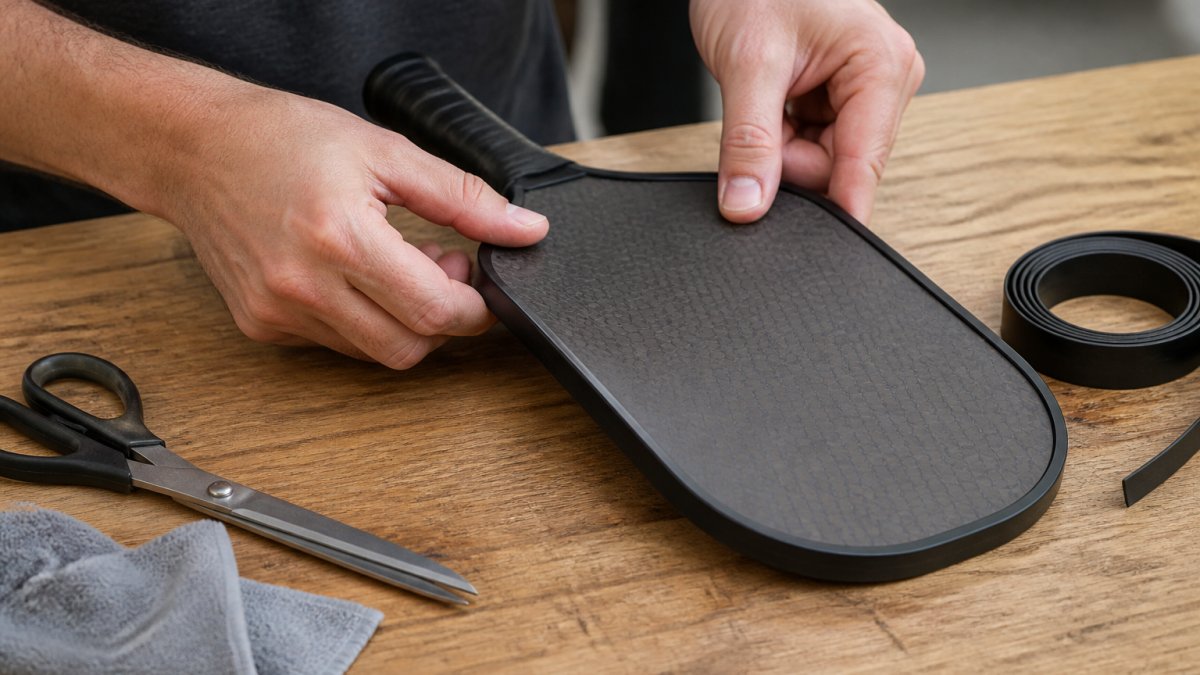
Here's how to apply pickleball edge guard tape so it stays put:
- Clean the rim with isopropyl alcohol and let it dry fully.
- Start at the throat, pressing the first inch firmly.
- Work around the head in small sections, heating gently as you go.
- Stretch around curved edges with light tension, not force.
- Press the full strip with a roller or your thumb.
- Trim the overlap with a sharp blade.
Surface preparation is the step most people skip. A greasy rim defeats any adhesive, no matter how good the tape is.
Weight, Warranty, and Adhesive: The Details That Decide the Repair
Three details decide whether a repair is worth doing: added weight, warranty terms, and adhesive compatibility. Most guides mention them in passing. Here is what actually happens to your paddle.
Weight and Swing Weight: What a New Guard Does to Your Paddle
A fresh edge guard adds a small amount of mass at the rim, which can change how the paddle feels in hand.
What players notice:
If you are sensitive to swing weight, weigh your strip before applying on a kitchen scale accurate to 0.1 grams. Compare it to the old one, if the difference is more than a gram or two, apply it and test a session before committing. Lead tape users should account for the guard first, then add lead only if the paddle still feels light.
Warranty Implications: Check Before You Cut
Warranty terms vary by manufacturer, and modifying the rim may affect coverage. Some brands treat tape replacement as normal wear-and-tear maintenance; others consider any rim modification, including trimming or adding adhesive, a warranty violation. Policies vary by brand and by whether the damage you are repairing was itself a defect.
Before you cut anything:
- Read the warranty terms for your specific paddle. Look for language about "modification," "alteration," and "normal wear."
- Document the original condition with photos before removal. If a defect claim arises later, before-and-after photos help.
- Ask the manufacturer if the repair is covered or if they offer a rim service. A structural repair by the maker may cost less than a voided warranty on an expensive paddle.
If your paddle is under warranty and the rim damage is structural, contact the maker first.
Adhesive Compatibility: A Safety-First Guide
Some players add cyanoacrylate or epoxy for extra hold, and that is where repairs go wrong.
- Pressure-sensitive acrylic: Bonds to the rim without solvents that migrate into the core. Removable if you need to redo the job. The default for a reason.
- Cyanoacrylate: Cures brittle and cracks under impact on a flexible rim. Runoff can wick into the core seam and stiffen the edge. Test on a hidden spot first, and never use it as a topcoat over pressure-sensitive tape.
- Epoxy: Strongest hold, but the exothermic cure can warp a thin rim if applied too thickly, and removal is nearly impossible without damaging the face. Reserve it for structural repairs.
If you are weighing whether a repair or a new paddle makes more sense, our guide to what makes a high performance pickleball paddle covers the specs that matter, including how weight affects play.
Protect Your Freshly Guarded Paddle With the Right Cover
A fresh edge guard deserves protection between sessions. A cover keeps dust off the adhesive edges and stops the rim from knocking against your bag.
A common mistake is tossing a freshly guarded paddle loose in a gear bag. Zippers and water bottles do the same damage the court does.
Our pickleball paddle cover keeps your paddle snug between sessions, so the new guard stays clean and the face stays protected.

Frequently Asked Questions
How do you replace a pickleball paddle edge guard?
Peel off the old guard or tape, clean the rim with isopropyl alcohol, and let it dry fully. Cut a new strip to length, start at one end and press it down along the edge, working around the curves without stretching. Smooth out bubbles as you go and let the adhesive cure before play. Most edge guard replacement jobs take 20 to 30 minutes, and the paddle should sit unused for the curing time listed on the tape.
Can a damaged edge guard affect a pickleball paddle?
Yes. The edge guard absorbs impacts when the paddle scrapes the court or clips another paddle. Once it chips or peels away, the honeycomb core and face material take those hits directly, which can lead to cracking or core delamination. A worn guard also changes how the paddle feels on off-center hits. Replacing it early is far cheaper than replacing the paddle.
What kind of tape should you use on a pickleball paddle edge guard?
Use edge guard tape made for pickleball paddles, usually a peel and stick PVC strip sized to your rim width. PVC holds up to friction and impact better than electrical or athletic tape, which wear through quickly. Avoid permanent tape on a paddle that is still under warranty, since removing it can void coverage. Match the strip width to your paddle's edge so it wraps cleanly without overhang.
Can you replace an edge guard on a custom pickleball paddle?
You can, and the process is the same as on a stock paddle. Check the warranty terms first, because some makers require professional service or void coverage if you remove the factory guard. On a custom paddle, keep the new strip narrow enough that it does not cover any printed design on the face. A paddle cover like the Salted City Sports Pickleball Paddle Cover ($10.00) protects the fresh edge between sessions.
Edge guards wear out. Cores don't have to. When a repair no longer makes sense, it's time for a paddle built to last. Salted City Sports makes USA Pickleball Approved paddles with an extra-large sweet spot, a high-grit coating for control and spin, and a comfortable, long-lasting grip. Every paddle is fully customizable by our in-house design team, with no minimum order. Get started with Salted City Sports and put a paddle on the court that plays as good as it looks.
